English
 Español
 Русский
 لالعربية

GMP Compliant Mixing Equipment for Pharma Manufacturing
وقت النشر:
2026-06-26
Source GMP compliant mixing equipment from DEYUE MACHINERY. Explore our pharmaceutical mixer lineup built for pharma-grade mixing reliability. Contact us today.
Pharmaceutical manufacturing demands precision and unwavering adherence to Good Manufacturing Practice standards. At the heart of every reliable production line sits a properly engineered mixing system capable of handling everything from low-viscosity liquids to high-solids powders without compromising product integrity. GMP compliant mixing equipment is not merely a regulatory checkbox — it is the foundation upon which drug safety, efficacy, and batch-to-batch uniformity are built.
DEYUE MACHINERY designs and manufactures industrial mixers specifically engineered for the pharmaceutical sector. Our GMP mixing solutions meet the rigorous requirements of FDA 21 CFR Part 210 and 211, EU GMP Annex 1, and China's NMPA pharmaceutical equipment standards, ensuring every unit shipped is ready for validation in a cGMP production environment.
Why GMP Compliance Matters in Pharmaceutical Mixing
The pharmaceutical industry operates under strictest quality controls of any manufacturing sector. Mixing is one of the most critical unit operations because it directly determines the homogeneity of active pharmaceutical ingredients, excipients, solvents, and intermediates. Even minor deviations in mixing performance can lead to content uniformity failures, dissolution issues, and patient safety risks.
GMP compliance for mixing equipment encompasses several dimensions. The equipment must be constructed from materials compatible with pharmaceutical processing — typically 316L stainless steel with electropolished internal surfaces achieving a Ra value of 0.4 micrometers or less. All wetted components must be designed for complete drainage to prevent cross-contamination between batches. Seals, gaskets, and bearings must be positioned outside the product zone wherever possible to eliminate lubricant migration risks. Furthermore, every piece of GMP mixing equipment must support Clean-in-Place (CIP) and Sterilize-in-Place (SIP) protocols, enabling automated cleaning cycles that are fully documented and validated.
Core Technologies in DEYUE's Pharmaceutical Mixer Portfolio
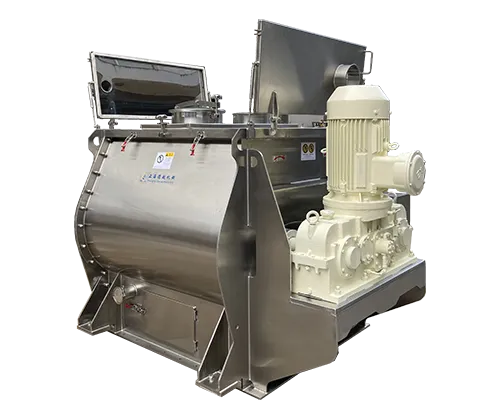
DEYUE offers a comprehensive range of pharmaceutical mixers, each engineered for specific process requirements within the GMP framework. Understanding the distinctions between these technologies is essential for selecting the right equipment for your formulation.
V-Type Blenders for Powder Blending
V-type blenders utilize a dual-tube V-shaped vessel that rotates around a horizontal axis. The geometry creates a continuous dividing and recombining flow pattern ideal for free-flowing powder blends. These mixers achieve homogeneous distribution of low-solid-content APIs with excipients in 5–15 minute cycle times. The sealed design minimizes dust generation and allows operation under nitrogen atmosphere for oxygen-sensitive formulations.
Dry Granulation Mixers
High-shear dry granulation mixers combine powder blending with binder incorporation in a single vessel. Equipped with a bottom-mounted chopper and side-mounted impeller, these units can process formulations ranging from 50 to 500 liters batch capacity. The adjustable impeller speed (typically 50–500 RPM) and chopper speed (300–3000 RPM) allow precise control over granule size distribution and density, critical parameters for downstream tablet compression.
Liquid-Liquid and Liquid-Solid Mixers
For emulsions, suspensions, and solution-based formulations, DEYUE's homogenizing mixers employ rotor-stator technology with variable frequency drives. These units generate shear rates exceeding 10,000 per second, producing droplet sizes in the sub-micron range. The closed-system design prevents contamination and allows sterile processing when integrated with isolator technology.
Technical Specifications Comparison
The following table compares key specifications across DEYUE's primary GMP mixing equipment categories to assist engineers and procurement teams in making informed equipment selection decisions.
| Specification | V-Type Blender | High-Shear Granulator | Homogenizer Mixer | Ribbon Blender |
|---|---|---|---|---|
| Batch Capacity | 50 – 2,000 L | 50 – 1,000 L | 100 – 3,000 L | 100 – 5,000 L |
| Motor Power | 1.5 – 15 kW | 5.5 – 55 kW | 7.5 – 90 kW | 4 – 30 kW |
| Impeller Speed Range | 10 – 40 RPM | 50 – 500 RPM | 500 – 3,600 RPM | 30 – 80 RPM |
| Surface Finish (Ra) | ≤ 0.4 μm | ≤ 0.4 μm | ≤ 0.4 μm | ≤ 0.8 μm |
| CIP/SIP Capability | Yes | Yes | Yes | Optional |
| Seal Type | Dual mechanical seal | Dual mechanical seal | Single/Dual mechanical seal | Packed gland / Sealless |
| Material Contact Parts | 316L SS | 316L SS | 316L SS | 316L SS |
| Typical Application | Powder blending | Dry/Wet granulation | Emulsions, suspensions | High-viscosity pastes |
| Dust Containment | Nitrogen purging | Closed lid with vacuum | Enclosed reactor design | Optional cover |
Design Features That Ensure GMP Compliance
Selecting a pharma grade mixer requires evaluating the equipment against specific design criteria that regulators scrutinize during inspections and validations.
- Material of Construction: All product-contact surfaces use 316L austenitic stainless steel with documented mill certificates. Welds are orbital TIG welded and ground flush, with no crevices or dead legs that could harbor microbial growth.
- Surface Finish: Internal surfaces are electropolished to Ra ≤ 0.4 μm for liquid-contact zones and Ra ≤ 0.8 μm for powder-contact zones, reducing material adhesion and facilitating effective cleaning verification.
- Drainability: Vessels are sloped with a minimum 2-degree gradient toward drain ports located at the lowest point. No product residue remains after complete drainage, satisfying GMP requirements for visual cleanliness inspection.
- Sealing Systems: Dual mechanical seals with barrier fluid monitoring prevent shaft leakage into the product zone. Seal faces are carbon-inert material combinations rated for temperatures up to 200°C and pressures up to 6 bar.
- Instrumentation Integration: Temperature probes, pressure transducers, torque sensors, and level indicators are all sanitary-grade fittings compatible with SIP sterilization. Data logging interfaces support 21 CFR Part 11 electronic records compliance.
- Access and Inspection: Large-diameter sanitary manways with quick-release clamps enable thorough visual inspection and swab sampling for residual verification. All access points are equipped with silicone-free EPDM or PTFE gaskets rated for repeated thermal cycling.
Validation and Qualification Support
One of the most significant challenges pharmaceutical manufacturers face is equipment qualification. DEYUE provides comprehensive documentation packages to streamline the Installation Qualification (IQ), Operational Qualification (OQ), and Performance Qualification (PQ) process. Each mixer ships with a detailed Factory Acceptance Test (FAT) protocol, including motor performance curves, vibration analysis reports, and surface finish verification certificates.
For mixing homogeneity validation, DEYUE can perform tracer studies using potassium iodide or titanium dioxide markers, demonstrating blend uniformity coefficients of variation below 2% — well within pharmacopeial specifications. These studies are conducted at the customer's specified fill levels and discharge configurations, providing realistic data for the site's master validation protocol.
Choosing the Right GMP Mixing Equipment for Your Process
Selecting the optimal pharmaceutical mixer depends on multiple factors: the physical properties of your formulation (powder flowability, viscosity, particle size distribution), the scale of production, cleaning requirements between batches, and the regulatory classification of the product. A solid-dose tablet facility processing dry blends will have fundamentally different requirements from a biologics manufacturing line producing sterile emulsions.
DEYUE's engineering team works closely with formulation scientists and process engineers during the equipment specification phase. We conduct pilot-scale trials at our demonstration center to validate mixing parameters, optimize cycle times, and confirm cleaning effectiveness before committing to full-scale manufacturing equipment. This collaborative approach reduces commissioning risk and accelerates time-to-market for new pharmaceutical products.
Conclusion
GMP compliant mixing equipment represents a critical investment in pharmaceutical manufacturing quality and regulatory readiness. From material selection and surface engineering to validation documentation and process support, every aspect of the mixing system must be designed with compliance as a core requirement rather than an afterthought. DEYUE MACHINERY brings decades of specialized expertise in pharmaceutical mixer design, delivering pharma grade mixer solutions that meet the most demanding GMP standards worldwide.
Contact DEYUE MACHINERY to discuss your mixing requirements and receive a customized equipment recommendation.
Phone: +86 13917895463
Email: [email protected]
Website:https://www.deyuemixer.com/
تصنيف:
أخبار ذات صلة


عنوان البريد الإلكتروني:
الخط الساخن: