English
 Español
 Русский
 لالعربية

How to Choose the Right Ribbon Blender Mixer: The Complete Industrial Buyer's Guide 2026
وقت النشر:
2026-06-21
Looking for the perfect ribbon blender mixer? Compare types, specs, and key selection criteria. Expert buying guide from Shanghai Deyue Machinery.
How to Choose the Right Ribbon Blender Mixer: The Complete Industrial Buyer's Guide
Introduction
Choosing the right ribbon blender mixer is one of the most critical decisions in your industrial mixing process. Whether you're producing food additives, pharmaceutical powders, chemical fertilizers, or construction materials, the performance of your ribbon blender mixer directly impacts product quality, operational efficiency, and bottom-line costs.
With dozens of manufacturers and hundreds of models available globally, navigating the ribbon blender mixer market can feel overwhelming. This comprehensive guide cuts through the noise, giving you the practical knowledge you need to make an informed purchasing decision.
Shanghai Deyue Machinery has been manufacturing industrial mixing equipment since 2012. Over the years, we've helped thousands of businesses worldwide select the right mixing solution. Today, we're sharing our expertise to help you find the perfect ribbon blender mixer for your application.
What Is a Ribbon Blender Mixer?
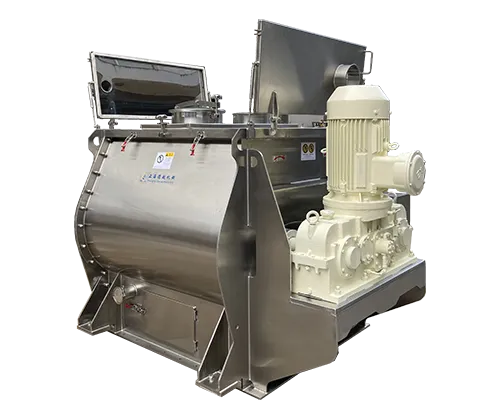
A ribbon blender mixer is a type of dry powder and granule mixing equipment that uses a double-layer ribbon agitator inside a U-shaped trough. The outer ribbon pushes material outward while the inner ribbon pushes material inward, creating a continuous cross-flow mixing pattern that achieves uniform blending in a relatively short cycle time.
How Does a Ribbon Blender Mixer Work?
The working principle of a ribbon blender mixer is elegantly simple:
- Loading: Raw materials are loaded through the feed port, often via vacuum conveyor or manual loading
- Mixing: The dual-ribbon agitator rotates at a calculated speed, creating both convective and diffusive mixing
- Discharge: Once the target mix uniformity is achieved, the discharge valve opens and the mixed product is emptied
The ribbon design ensures that even hard-to-mix materials, such as powders with significantly different densities or particle sizes, are blended thoroughly and consistently.
Key Components of a Ribbon Blender Mixer
- Mixing Chamber (U-shaped trough): The main body where mixing occurs, typically constructed from stainless steel (SS304 or SS316L) for food and pharma grade, or carbon steel with protective coating for industrial applications
- Dual Ribbon Agitator: The heart of the mixer, designed for optimal material flow and minimal dead zones
- Drive System: Motor, reducer, and coupling that power the agitation
- Sealing System: Shaft seals (mechanical seal or packing seal) prevent powder leakage
- Discharge Valve: Butterfly valve, manual, pneumatic, or automatic
- Cover: Equipped with viewing ports, cleaning ports, and dust extraction connections
- Control Panel: PLC or electrical control system for operation monitoring
Types of Ribbon Blender Mixers
Understanding the different types of ribbon blender mixer configurations helps you match the equipment to your specific needs:
1. Standard Ribbon Blender Mixer
The most common configuration, ideal for general-purpose dry powder mixing. Suitable for chemical powders and granules, food ingredient blending, animal feed mixing, and fertilizer production.
2. Spray Liquid Ribbon Blender Mixer
Equipped with a liquid spray system for applications requiring binder addition or moisture control. The spray bar distributes liquid evenly across the powder bed during mixing.
3. Jacketed Ribbon Blender Mixer
Features a jacketed mixing chamber that allows steam, hot water, or cooling water circulation. Essential for temperature-sensitive processes like wax-coated powder mixing and molten ingredient incorporation.
4. Vacuum Ribbon Blender Mixer
Operates under negative pressure, ideal for toxic or hazardous powder handling, dust-free mixing environments, and pharmaceutical grade production.
5. High-Shear Ribbon Blender Mixer
Combines ribbon mixing with an integrated high-speed disperser for applications requiring both dry blending and wet mixing in a single vessel.
6. Double-Shaft Ribbon Blender Mixer
Uses two parallel mixing shafts for higher throughput and more intensive mixing, suitable for large-scale industrial operations.
Critical Selection Criteria for Your Ribbon Blender Mixer
1. Material Characteristics
Your raw materials dictate the mixer specifications:
- Particle Size: Fine powders (below 50 microns) require different blade geometry than coarse granules (above 5mm)
- Bulk Density: Lightweight materials (0.2-0.5 g/cm³) behave differently from heavy materials (above 1.0 g/cm³)
- Flow Properties: Free-flowing powders mix differently from cohesive or bridging materials
- Corrosiveness: Acidic or alkaline materials may require SS316L or special coatings
- Hygiene Requirements: Food-grade and pharma-grade applications demand sanitary design (CIP-capable, polished interior surfaces)
2. Required Capacity
Deyue Machinery recommends calculating your mixer capacity based on batch volume (typically fill the mixer to 60-80% of total volume), production rate, and cycle time. Common ribbon blender mixer capacities range from 50L laboratory scale to 20,000+ liters for large industrial use.
3. Mixing Uniformity Requirements
Different industries have different homogeneity standards:
- Food Industry: CV (Coefficient of Variation) ≤ 5%
- Pharmaceutical Industry: CV ≤ 3%
- Chemical Industry: CV ≤ 8%
- General Industrial: CV ≤ 10%
4. Drive System Configuration
The motor and reducer selection affects performance and maintenance. Variable Frequency Drive (VFD) allows speed adjustment for different materials, and heavy-duty bearings extend service life in demanding applications.
5. Sealing Technology
Modern ribbon blender mixer designs offer mechanical seals for vacuum applications, double mechanical seals with nitrogen barrier for maximum containment, and packing seals as a cost-effective traditional option.
6. Discharge Mechanism
Choose based on your production workflow: manual discharge for small batches, pneumatic discharge for automated packaging lines, or hydraulic discharge for heavy or compacted materials.
7. Control System
Options range from basic electrical control with timer-based operation to full PLC control panels with touch screen interface, recipe management, and parameter storage.
Industry Applications of Ribbon Blender Mixers
Food & Beverage
Spice and seasoning blends, protein powder and nutritional supplements, flour and baking mixes, instant drink powder formulations, ice cream mix and dairy powders.
Pharmaceuticals
Active pharmaceutical ingredients (APIs) blending, dietary supplement formulations, herbal medicine powder mixing, tablet and capsule pre-mixes.
Chemical Industry
Pesticides and herbicides, fertilizers and soil conditioners, detergent powders and cleaning agents, plastic and rubber additives, pigments and dyes.
Construction Materials
Dry mortar and tile adhesive, putty powder and wall coatings, fireproof materials and insulation compounds, self-leveling cement formulations.
Animal Feed
Compound feed premixes, mineral vitamin supplements, pet food ingredient blending, aquatic feed powders.
Ribbon Blender Mixer Technical Specifications
| Parameter | Range |
|---|---|
| Capacity | 50L - 20,000L per batch |
| Motor Power | 1.5kW - 90kW |
| Rotational Speed | 20-60 rpm (adjustable with VFD) |
| Mixing Time | 3-10 minutes per batch |
| Uniformity | CV ≤ 3-5% |
| Power Consumption | 0.5-2.0 kWh per batch |
| Liner Material | SS304 / SS316L / Carbon Steel |
| Standard Compliance | CE, ISO, GMP (optional) |
Frequently Asked Questions About Ribbon Blender Mixers
What is the typical lifespan of a ribbon blender mixer?
With proper maintenance, a quality ribbon blender mixer lasts 10-15 years or more. Key factors affecting lifespan include material abrasiveness, operating frequency, and maintenance practices.
How do I calculate the right mixer size for my production?
Divide your hourly production requirement by the number of batches you plan to run per hour, then divide by your fill ratio (typically 60-70%). For example, if you need 2,000 kg/hour with 4 batches/hour and 65% fill ratio, you need a mixer with approximately 770L capacity.
What is the difference between a ribbon blender mixer and a paddle mixer?
Ribbon blenders excel at gentle mixing of dry powders and granules with similar flow characteristics. Paddle mixers are better for cohesive, sticky, or slightly moist materials that require more aggressive mixing action.
How much does a ribbon blender mixer cost?
Prices vary significantly based on capacity, material construction, automation level, and customizations. A basic 500L carbon steel ribbon blender starts around $3,000-$5,000, while a large 5,000L SS316L pharmaceutical-grade unit with PLC control can range from $20,000-$50,000+.
Can a ribbon blender mixer handle wet and dry materials together?
Standard ribbon blenders are designed for dry powder mixing. However, spray liquid ribbon blender mixers can handle small amounts of liquid binders (typically 1-10% by weight).
Conclusion
Selecting the right ribbon blender mixer requires careful consideration of your material properties, production requirements, hygiene standards, and budget. By understanding the key selection criteria outlined in this guide, you'll be well-equipped to evaluate suppliers and make an informed decision.
Shanghai Deyue Machinery brings 14+ years of manufacturing expertise, a global track record, and a commitment to custom-engineered solutions. Whether you need a small laboratory-scale mixer or a large industrial production line, we have the expertise and capacity to deliver.
Ready to find your perfect ribbon blender mixer?
Contact our engineering team for a free consultation and customized quotation:
- Email: [email protected]
- Phone: +86 13917895463
- Website: www.deyuemixer.com
تصنيف:
أخبار ذات صلة


عنوان البريد الإلكتروني:
الخط الساخن: