English
 Español
 Русский
 لالعربية

Dry Powder Mixing: Techniques for Uniform Blend Distribution
Fecha de publicación:
2026-06-26
Master dry powder mixing techniques for consistent blend distribution. Learn powder blending methods, equipment selection, and quality control tips. Contact DEYUE MACHINERY today.
Dry Powder Mixing: Techniques for Achieving Uniform Blend Distribution
In pharmaceutical manufacturing, food processing, chemical production, and construction materials, the quality of a finished product often hinges on how well individual powder components are blended together. Dry powder mixing is a critical unit operation that determines the homogeneity, consistency, and performance of powders ranging from active pharmaceutical ingredients to cement additives. Achieving true dry mix uniformity requires a deep understanding of powder behavior, equipment selection, and process parameters.
Understanding the Fundamentals of Dry Powder Mixing
Dry powder mixing refers to the mechanical process of combining two or more particulate solids to achieve a homogeneous distribution of each component throughout the mixture. Unlike liquid mixing, which relies on convective flow, dry powder mixing involves complex interactions between particle size, density, shape, surface texture, and electrostatic charge. These factors collectively influence segregation tendencies, flowability, and the ultimate quality of the blend.
The goal of any powder blending operation is to reach a state where a sample taken from any location in the mixer yields the same composition as the bulk material. In practice, this ideal is approached through careful control of mixing time, equipment design, and feed strategy. Engineers typically measure blend quality using statistical methods such as the coefficient of variation (CV), where a CV below 5% is generally considered acceptable for most industrial applications.
Key Factors Affecting Powder Mix Uniformity
Several physical and operational variables directly impact the effectiveness of dry powder mixing and the resulting dry mix uniformity:
Particle Size Distribution: Wide variations in particle size promote segregation through percolation, where fine particles migrate downward through voids between larger particles. A narrow, controlled particle size distribution improves blend stability.
Particle Density: Significant density differences between components cause gravitational separation during mixing and discharge. Lighter particles tend to rise while heavier particles settle, undermining powder blending quality.
Particle Shape and Surface Texture: Irregularly shaped or rough-surfaced particles interlock more effectively, reducing segregation. Spherical, smooth particles flow freely but are more prone to stratification.
Moisture Content: Excess moisture causes agglomeration and caking, while extremely dry conditions increase electrostatic attraction between particles, leading to clumping and poor dispersion.
Bulk Density and Flowability: Poorly flowing powders require more energy and longer mixing times to achieve uniform distribution. The Hausner ratio and Carr's index are commonly used to assess powder flow characteristics.
Common Dry Powder Mixing Equipment and Their Applications
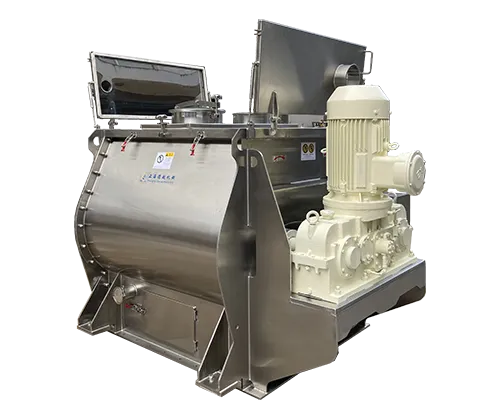
Selecting the right mixer is one of the most important decisions in powder mixing techniques. Different mixer designs excel under different operating conditions. Below is a comparison of the most widely used industrial mixers for dry powder processing:
| Mixer Type | Mixing Mechanism | Best For | Cycle Time | Max Capacity |
|---|---|---|---|---|
| V-Blender | Tumbling and convective flow | Free-flowing powders, gentle mixing | 5–15 min | Up to 3,000 L |
| Double Cone Blender | Rolling and convective flow | Uniform blends of cohesive and free-flowing powders | 8–20 min | Up to 5,000 L |
| Ribbon Blender | Shear and convective flow | Semi-solid pastes, highly cohesive powders | 3–10 min | Up to 10,000 L |
| Paddle Mixer | High-shear convective flow | Dense, hard-to-blend materials | 2–8 min | Up to 8,000 L |
| Ploughshare Mixer | Intensive shear and convective flow | Agglomerating, sticky, or fibrous powders | 1–5 min | Up to 6,000 L |
| Bin Blender (V-Blender variant) | Low-shear tumbling | Pharmaceutical blends, fragile particles | 10–30 min | Up to 2,000 L |
Optimizing Powder Mixing Techniques for Consistent Results
Achieving reliable dry powder mixing outcomes requires a systematic approach to process optimization. The following strategies are proven to enhance dry mix uniformity and reduce batch-to-batch variability:
1. Proper Sequence of Ingredient Addition
The order in which ingredients are added significantly affects blend quality. The general principle is to add the largest volume component first, followed by intermediate amounts, and finally the smallest-volume or highest-potency ingredient (such as an active pharmaceutical ingredient or colorant). For trace ingredients, a geometric dilution approach is recommended: the potent component is first diluted with an equal weight of carrier, then that mixture is blended with twice its weight of additional carrier, and so on, until the full batch volume is reached.
2. Optimizing Fill Volume
Overfilling a mixer reduces the available space for material movement, leading to inadequate mixing and increased dead zones. Underfilling wastes capacity and may cause excessive particle attrition. Most tumble blenders operate optimally at 30% to 60% fill volume, while ribbon and paddle mixers typically perform best between 50% and 75% fill.
3. Controlling Mixing Time
More mixing time does not always equal better results. Overmixing can induce segregation, increase particle degradation, and waste energy. The optimal mixing time should be determined experimentally by sampling the blend at regular intervals and measuring the CV of a representative component. The minimum time required to reach the target CV is the optimal mixing duration.
4. Managing Discharge Procedures
Segregation frequently occurs during discharge, especially when material flows through a single outlet at the bottom of a mixer. Center-discharge configurations, multiple discharge ports, or bottom-discharge chutes with controlled flow rates help maintain blend uniformity. Some mixers incorporate in-line screening at discharge to break up agglomerates and ensure a consistent product stream.
5. Environmental Controls
Temperature and humidity in the mixing environment can affect powder behavior. High humidity promotes moisture absorption and agglomeration, while very low humidity increases static electricity. Controlled environments with humidity levels maintained between 40% and 60% RH are recommended for sensitive formulations.
Quality Control and Testing Methods
Validating powder blending quality is essential for regulatory compliance and product consistency. Common quality control measures include:
Sampling Protocol: Collect samples from multiple locations (top, middle, bottom, center, edges) at various stages of the mixing cycle. At least ten samples per batch are recommended for statistical reliability.
Assay Testing: Analyze a key component (such as an API or pigment) using HPLC, UV-Vis spectroscopy, or other validated analytical methods to determine concentration at each sampling point.
Visual Assessment: For colored powders, a simple visual comparison of samples against a standard can quickly identify gross non-uniformity.
Particle Size Analysis: Laser diffraction or sieve analysis confirms that particle size distributions remain consistent before and after mixing, ensuring no segregation has occurred.
Residual Moisture Testing: Karl Fischer titration or loss-on-drying methods verify that moisture content has not shifted during the mixing process.
Conclusion
Achieving uniform blend distribution in dry powder mixing is not a one-size-fits-all solution. It requires careful consideration of powder properties, appropriate equipment selection, optimized process parameters, and rigorous quality control. Whether you are formulating pharmaceutical tablets, producing specialty chemicals, or manufacturing construction compounds, mastering the science of powder blending is essential for product quality and operational efficiency.
At DEYUE MACHINERY, we specialize in designing and manufacturing high-performance industrial mixing equipment tailored to your specific dry powder mixing requirements. Our mixers are engineered for maximum blend uniformity, minimal residue, easy cleaning, and long-term reliability across diverse industries.
If you need expert guidance on selecting the right mixer for your application or want to optimize your current powder mixing techniques, our engineering team is ready to help.
Contact DEYUE MACHINERY today:
Phone: +86 13917895463
Email: [email protected]
Website: https://www.deyuemixer.com/
Etiqueta:
Noticias relacionadas


Dirección de correo electrónico:
Línea directa:
Copyright © 2012-2026 Shanghai Deyue Powder Machinery Co., Ltd. All rights reserved