Mezcladora de cinta horizontal en procesamiento de alimentos: cómo lograr una uniformidad de mezcla perfecta


Fecha de publicación:

2026-06-22

Cómo una mezcladora de cinta horizontal logra uniformidad alimentaria (CV < 5%), con parámetros DLH, diseño sanitario y guía de selección.

La uniformidad es el atributo que decide si una mezcla alimentaria pasa el control de calidad o se rechaza. Una mezcla de condimentos con un 6% de sal en una cucharada y un 9% en otra es un retiro de producto en espera. La mezcladora de cinta horizontal sigue siendo la máquina principal para mezclar alimentos en seco porque su agitador de cinta de contracorriente mueve el material de las paredes al centro y viceversa, reduciendo el coeficiente de variación (CV) por debajo del 5% en minutos, no en decenas de minutos.

Por qué importa la uniformidad en la producción de alimentos

En el procesamiento de alimentos, "mezclado" no es un estado binario. Los clientes y los auditores se fijan en el coeficiente de variación (CV) del componente crítico en todo el lote. Para aditivos en polvo, portadores de sabor y premezclas, un CV inferior al 5% es el objetivo habitual. La cinta externa de la mezcladora barre el material hacia el eje mientras la interna lo empuja hacia afuera, de modo que cada partícula pasa repetidas veces por la zona central de alto cizallamiento — eso es lo que reduce rápidamente el CV.

Cómo funciona una mezcladora de cinta horizontal

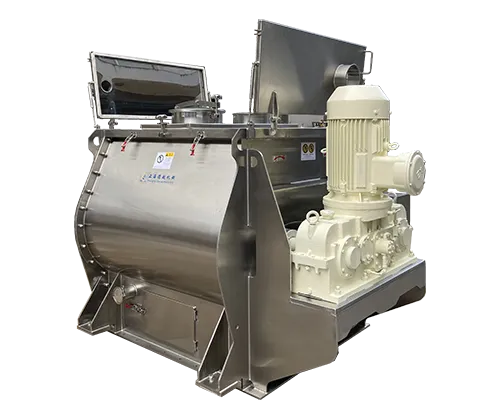
La serie DLH usa una cuba en forma de U o O con una cinta helicoidal doble sobre un único eje horizontal. Las cintas directa e inversa en el mismo eje crean una celda de convección de baja potencia: el material se eleva en la pared, cae en el centro y se vuelve a elevar. Como el movimiento es axial y radial, incluso adiciones pequeñas como un 0,1% de vitamina traza se dispersan uniformemente. El tiempo de mezcla para polvos fluibles es típicamente de 3 a 15 minutos según la carga y la friabilidad.

Diseño sanitario para uso alimentario

Las piezas en contacto con el alimento son de SS304 de serie y SS316L donde lo exige la corrosión o los cloruros. La cuba admite una puerta de limpieza totalmente abierta, y la válvula de descarga en arco encaja al ras con la pared, sin rincones muertos. Para recetas pegajosas o aceitosas se añaden una cinta rascadora y una barra de pulverización de líquido para combinar polvos y líquidos (aceites, lecitina, enzimas) en una sola pasada.

Dónde usan las plantas de alimentos la mezcladora DLH

La máquina cubre toda la gama de tareas de alimentos secos: mezclas de especias y condimentos, premezclas de aditivos alimentarios, mezcla de harinas y mejoradores de panificación, homogenización de proteínas y polvos nutricionales, y bases para alimento para mascotas. Muchas forman parte de la línea de producción de aditivos alimentarios, donde la distribución uniforme de microingredientes es obligatoria.

Mezcladora de cinta DLH de gran escala — parámetros típicos

ModeloVolumen útil (L)Potencia total (kW)Factor de cargaTiempo (min)
DLH-300120–1802,2–40,4–0,63–8
DLH-1000400–6005,5–7,50,4–0,64–10
DLH-30001200–180011–150,4–0,65–12
DLH-80003200–480022–370,4–0,66–15
DLH-150006000–900045–1100,4–0,68–15

Toda la familia DLH abarca de 35 a 15000 L de volumen útil y de 2,2 a 110 kW de potencia total en 17 modelos estándar; los valores anteriores son puntos representativos. La densidad aparente, el tamaño de partícula y la fluidez cambian la elección final, así que confirme con una mezcla de prueba antes de pedir.

Cómo elegir el volumen adecuado

Dimensione para su lote real, no para el pico. Las mezcladoras de cinta rinden mejor al 40–60% de llenado; sobrellenar ahoga la convección y eleva el CV. Si fabrica muchos SKU pequeños, una unidad de 300–1000 L con puerta de apertura rápida supera a un tanque sobredimensionado que nunca puede limpiar entre recetas.

Mantenimiento que protege la higiene

Tras ciclos con alérgenos o colorantes, limpie en seco y luego con CIP húmedo la cuba y la cinta. Inspeccione mensualmente la junta de silicona de la válvula de descarga — una junta gastada es la causa habitual de contaminación entre lotes. Mantenga el aceite del reductor dentro de especificación; la mayoría de las quejas de "ruido de mezcla" vienen de un reductor cansado, no de las cintas.

Equipos relacionados

Para deberes de alta densidad o pasta, compare la mezcladora DPH de cinta y paleta; para líneas continuas vea la mezcladora DJH de doble eje. Todas comparten la construcción sanitaria de Deyue y están documentadas en la página del producto DLH.

Etiqueta:


Si desea conocer más detalles sobre una empresa concreta, visite nuestro sitio web oficial, donde encontrará información completa y detallada.


Copyright © 2012-2026 Shanghai Deyue Powder Machinery Co., Ltd. All rights reserved
Deje su mensaje

Si tiene alguna sugerencia o pregunta para nosotros, ¡no dude en contactarnos!

DJH Double-Shaft Paddle Mixer
We use cookie to improve your online experience. By continuing to browse this website, you agree to our use of cookie.

Cookies

Please read our Terms and Conditions and this Policy before accessing or using our Services. If you cannot agree with this Policy or the Terms and Conditions, please do not access or use our Services. If you are located in a jurisdiction outside the European Economic Area, by using our Services, you accept the Terms and Conditions and accept our privacy practices described in this Policy.
We may modify this Policy at any time, without prior notice, and changes may apply to any Personal Information we already hold about you, as well as any new Personal Information collected after the Policy is modified. If we make changes, we will notify you by revising the date at the top of this Policy. We will provide you with advanced notice if we make any material changes to how we collect, use or disclose your Personal Information that impact your rights under this Policy. If you are located in a jurisdiction other than the European Economic Area, the United Kingdom or Switzerland (collectively “European Countries”), your continued access or use of our Services after receiving the notice of changes, constitutes your acknowledgement that you accept the updated Policy. In addition, we may provide you with real time disclosures or additional information about the Personal Information handling practices of specific parts of our Services. Such notices may supplement this Policy or provide you with additional choices about how we process your Personal Information.


Cookies

Cookies are small text files stored on your device when you access most Websites on the internet or open certain emails. Among other things, Cookies allow a Website to recognize your device and remember if you've been to the Website before. Examples of information collected by Cookies include your browser type and the address of the Website from which you arrived at our Website as well as IP address and clickstream behavior (that is the pages you view and the links you click).We use the term cookie to refer to Cookies and technologies that perform a similar function to Cookies (e.g., tags, pixels, web beacons, etc.). Cookies can be read by the originating Website on each subsequent visit and by any other Website that recognizes the cookie. The Website uses Cookies in order to make the Website easier to use, to support a better user experience, including the provision of information and functionality to you, as well as to provide us with information about how the Website is used so that we can make sure it is as up to date, relevant, and error free as we can. Cookies on the Website We use Cookies to personalize your experience when you visit the Site, uniquely identify your computer for security purposes, and enable us and our third-party service providers to serve ads on our behalf across the internet.

We classify Cookies in the following categories:
 ●  Strictly Necessary Cookies
 ●  Performance Cookies
 ●  Functional Cookies
 ●  Targeting Cookies


Cookie List
A cookie is a small piece of data (text file) that a website – when visited by a user – asks your browser to store on your device in order to remember information about you, such as your language preference or login information. Those cookies are set by us and called first-party cookies. We also use third-party cookies – which are cookies from a domain different than the domain of the website you are visiting – for our advertising and marketing efforts. More specifically, we use cookies and other tracking technologies for the following purposes:

Strictly Necessary Cookies
These cookies are necessary for the website to function and cannot be switched off in our systems. They are usually only set in response to actions made by you which amount to a request for services, such as setting your privacy preferences, logging in or filling in forms. You can set your browser to block or alert you about these cookies, but some parts of the site will not then work. These cookies do not store any personally identifiable information.

Functional Cookies
These cookies enable the website to provide enhanced functionality and personalisation. They may be set by us or by third party providers whose services we have added to our pages. If you do not allow these cookies then some or all of these services may not function properly.

Performance Cookies
These cookies allow us to count visits and traffic sources so we can measure and improve the performance of our site. They help us to know which pages are the most and least popular and see how visitors move around the site. All information these cookies collect is aggregated and therefore anonymous. If you do not allow these cookies we will not know when you have visited our site, and will not be able to monitor its performance.

Targeting Cookies
These cookies may be set through our site by our advertising partners. They may be used by those companies to build a profile of your interests and show you relevant adverts on other sites. They do not store directly personal information, but are based on uniquely identifying your browser and internet device. If you do not allow these cookies, you will experience less targeted advertising.

How To Turn Off Cookies
You can choose to restrict or block Cookies through your browser settings at any time. Please note that certain Cookies may be set as soon as you visit the Website, but you can remove them using your browser settings. However, please be aware that restricting or blocking Cookies set on the Website may impact the functionality or performance of the Website or prevent you from using certain services provided through the Website. It will also affect our ability to update the Website to cater for user preferences and improve performance. Cookies within Mobile Applications

We only use Strictly Necessary Cookies on our mobile applications. These Cookies are critical to the functionality of our applications, so if you block or delete these Cookies you may not be able to use the application. These Cookies are not shared with any other application on your mobile device. We never use the Cookies from the mobile application to store personal information about you.

If you have questions or concerns regarding any information in this Privacy Policy, please contact us by email at . You can also contact us via our customer service at our Site.