English
 Español
 Русский
 لالعربية

Double Shaft Paddle Mixer: Design Principles and Operational Optimization
release time:
2026-06-26
Discover double shaft paddle mixer design principles, paddle mixer design tips, and twin shaft mixer optimization strategies for industrial applications.
Double Shaft Paddle Mixer: Design Principles and Operational Optimization
In modern industrial processing, achieving uniform blending of powders, granules, and pastes is critical to product quality and operational efficiency. The double shaft paddle mixer has emerged as one of the most versatile and reliable mixing solutions across the chemical, pharmaceutical, and food industries. Understanding the engineering behind its paddle mixer design and implementing effective twin shaft mixer optimization strategies can significantly improve throughput, reduce energy consumption, and extend equipment lifespan.
Core Design Architecture of a Double Shaft Paddle Mixer
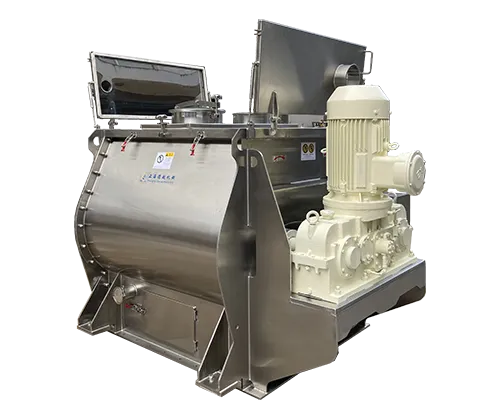
At the heart of every industrial paddle mixer lies a carefully engineered dual-shaft configuration. Two parallel horizontal shafts rotate within a U-shaped or cylindrical trough, each fitted with specially shaped paddles or blades. The counter-rotating motion of these shafts creates a complex fluid dynamic environment that promotes intense material movement and intermixing. Unlike single-shaft mixers, the dual-shaft arrangement ensures that material is continuously lifted, folded, and sheared from multiple directions simultaneously.
The paddle geometry is perhaps the most critical element of the paddle mixer design. Common paddle configurations include ribbon-type paddles, disc-type paddles, and angled blade arrangements. Ribbon paddles consist of helical strips wrapped around the shaft, providing strong axial material transport. Disc paddles offer superior shear forces ideal for viscous materials, while angled blades create a combination of longitudinal and transverse mixing actions. The selection of paddle type depends heavily on the material characteristics such as particle size distribution, bulk density, moisture content, and cohesiveness.
The trough design also plays a significant role in mixing performance. U-shaped troughs are preferred for dry powder mixing and granulation processes due to their self-cleaning geometry and minimal dead zones. Cylindrical troughs, on the other hand, are better suited for liquid-solid mixing applications where a higher fill level is required. Modern industrial paddle mixer models often incorporate adjustable bottom plates or wear-resistant liners to accommodate different material abrasiveness levels and facilitate easy maintenance.
Key Performance Parameters and Engineering Specifications
Evaluating the performance of a double shaft paddle mixer requires attention to several critical engineering parameters. The most fundamental specification is the mixing capacity, typically measured in cubic meters per batch or kilograms per hour. Capacity is determined by the trough volume, the fill ratio (usually 30% to 60% for optimal performance), and the rotational speed of the shafts. Overfilling the mixer reduces the available space for material movement and degrades mixing uniformity.
Rotational speed is another vital parameter that directly influences mixing intensity and residence time. Typical shaft speeds range from 15 to 60 RPM depending on the application. Higher speeds increase shear forces and reduce mixing time but may cause excessive wear on paddles and bearings. Lower speeds are suitable for fragile or cohesive materials that require gentle handling. The speed ratio between the two shafts is equally important — a slight differential speed (typically 1:1.05 to 1:1.2) enhances the inter-shaft material exchange and improves homogeneity.
| Parameter | Standard Range | Ideal Application |
|---|---|---|
| Trough Volume | 0.1 – 50 m³ | Scalable from lab to production |
| Shaft Speed | 15 – 60 RPM | Adjustable based on material type |
| Power Consumption | 0.75 – 300 kW | Dependent on density and viscosity |
| Mixing Time | 1 – 15 minutes | Varies with blend uniformity requirements |
| Fill Ratio | 30% – 60% | Optimal for uniform distribution |
| Motor Configuration | Dual independent drives | Allows speed ratio adjustment |
Twin Shaft Mixer Optimization Strategies for Maximum Efficiency
Twin shaft mixer optimization begins with understanding the material being processed. Different material classes — free-flowing powders, cohesive slurries, fibrous substances, and abrasive granules — each demand specific paddle configurations, shaft speeds, and filling strategies. Conducting small-scale pilot tests before full-scale deployment allows engineers to identify the optimal operating parameters and avoid costly trial-and-error in production environments.
One of the most effective optimization techniques involves adjusting the paddle overlap zone between the two shafts. The region where the paddles of opposing shafts pass close to each other generates intense shear and kneading action. By modifying the paddle spacing or adding intermediate baffles, operators can control the degree of mechanical action applied to the material. This is particularly valuable in pharmaceutical manufacturing where consistent particle size reduction and uniform drug distribution are regulatory requirements.
Another critical optimization factor is the discharge mechanism. Rapid and complete discharge minimizes residual material in the trough, reducing cross-contamination risks between batches and improving overall cycle time. Common discharge options include bottom gate valves, tilting trough designs, and pneumatic discharge systems. For hygienic applications in the food and pharmaceutical sectors, quick-release clamp fittings and CIP (Clean-in-Place) compatible designs ensure compliance with strict sanitation standards while maintaining high mixing efficiency.
Maintenance Best Practices and Wear Component Management
Proper maintenance is essential for maximizing the operational life of a double shaft paddle mixer and ensuring consistent mixing performance. The most wear-prone components include the paddles, shaft seals, bearings, and gearbox. Regular inspection schedules should monitor paddle wear patterns, seal integrity, and bearing temperatures. Early detection of abnormal wear prevents catastrophic failures and unplanned downtime that can disrupt entire production lines.
Lubrication management is equally important. High-quality gear oils and grease, applied according to manufacturer-recommended intervals, protect moving parts from friction-induced degradation. In corrosive or high-humidity environments, stainless steel construction and protective coatings on critical components significantly extend service life. Some advanced industrial paddle mixer models incorporate condition monitoring sensors that track vibration, temperature, and power draw in real time, enabling predictive maintenance approaches that minimize unexpected breakdowns.
Seal integrity deserves special attention since it directly affects both product purity and equipment reliability. Mechanical seals, labyrinth seals, and air purge systems are commonly employed to prevent material ingress into bearing housings. For applications involving toxic or hazardous materials, double mechanical seals with barrier fluid systems provide an additional layer of containment and operator safety.
Industry Applications and Sector-Specific Considerations
The versatility of the double shaft paddle mixer makes it suitable for a wide range of industrial applications. In the chemical industry, it is extensively used for blending dry additives, dispersing pigments, and coating granular substrates. The pharmaceutical sector relies on these mixers for uniform blending of active pharmaceutical ingredients with excipients, ensuring batch-to-batch consistency that meets stringent regulatory standards. Food manufacturers utilize paddle mixers for combining spices, flavorings, and nutritional supplements into powdered products such as protein mixes, soup bases, and baking blends.
Each industry brings unique requirements that influence paddle mixer design choices. Chemical processing often demands corrosion-resistant materials like Hastelloy or lined carbon steel, while food-grade applications require polished 316L stainless steel surfaces with sanitary tri-clamp connections. Pharmaceutical installations frequently need explosion-proof motors, dust-tight enclosures, and validated cleaning protocols to comply with GMP guidelines. Understanding these sector-specific demands is crucial when selecting or specifying a mixer for a particular application.
Conclusion
The double shaft paddle mixer represents a cornerstone of modern industrial mixing technology. Its robust paddle mixer design, combined with flexible twin shaft mixer optimization capabilities, delivers consistent performance across diverse material types and processing conditions. Whether you are scaling up a laboratory formulation or optimizing an existing production line, investing in the right mixing solution pays dividends in product quality, operational efficiency, and long-term cost savings.
If you are looking to enhance your mixing operations with a high-performance industrial paddle mixer, our team of engineering experts is ready to assist you with customized solutions tailored to your specific application requirements. Contact us today to discuss your project:
- Phone: +86 13917895463
- Email:[email protected]
- Website:https://www.deyuemixer.com/
label:
related news