English
 Español
 Русский
 لالعربية

Dust generation during powder mixing operations is one of the most persistent challenges facing industrial manufacturers. Excessive dust not only creates environmental hazards and material waste but also poses significant health risks to workers and can compromise product quality. Ribbon mixers, while highly effective for dry powder blending, require careful design and operational considerations to achieve truly dust-free performance.
Understanding Dust Generation in Powder Mixing
Powder particles smaller than 100 microns are particularly prone to becoming airborne during mechanical handling. When a ribbon blender agitates these fine powders, the shear forces and air turbulence created by the rotating ribbon can lift significant quantities of dust into the headspace of the mixer vessel. Without proper containment, this dust escapes through filling ports, discharge valves, and shaft seals.
The severity of dust generation depends on several factors including particle size distribution, bulk density, moisture content, mixing speed, fill level, and the geometry of the mixer internals. Fine powders with low bulk density (below 0.5 g/cm³) are especially problematic and require more sophisticated dust control measures.
Dust Control Strategies for Ribbon Mixers
1. Closed-Design Mixer Vessels
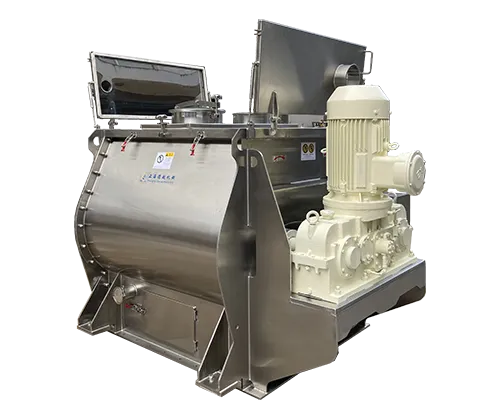
The most effective dust control begins with the mixer design itself. Closed-design ribbon mixers feature fully enclosed vessels with minimal openings, significantly reducing the pathways through which dust can escape. Modern closed ribbon mixers incorporate:
- Fully enclosed top covers: Removable panels with gasketed seals for charging and inspection
- Integrated dust collection ports: Strategically positioned connections for vacuum dust extraction systems
- Sealed discharge valves: Double-dump valve designs or butterfly valves with flexible seals
- Positive pressure containment: Slight negative pressure inside the vessel maintained by dust extraction fans
2. Advanced Shaft Seal Systems
Shaft seals represent one of the most critical dust escape points in ribbon mixer design. Traditional single-lip mechanical seals often fail to contain fine powder dust over extended operating periods. Advanced sealing solutions include:
- Dual mechanical seals: Two independent seal faces with inert gas or liquid barrier between them
- Labyrinth seals: Non-contact sealing using tortuous paths that trap and redirect escaping dust
- Piston ring seals: Self-adjusting carbon or PTFE piston rings that maintain contact despite shaft runout
- Sprung lip seals: Spring-loaded PTFE or NBR lips that compensate for wear and thermal expansion
3. Integrated Dust Collection Systems
Even with excellent enclosure design, some dust will inevitably be generated during powder charging and mixing. Effective dust collection systems work in tandem with the mixer to capture and remove airborne particles:
- Vacuum-assisted extraction: Dedicated vacuum pumps create slight negative pressure, drawing dust through collection ports
- Bag filter integration: On-board baghouse filters capture particles down to 1 micron and return them to the mix
- Cyclone pre-separation: Heavy particles separated by centrifugal force before finer filtration
- Automatic pulse-jet cleaning: Compressed air pulses that periodically clean filter media without stopping operation
4. Optimized Charging Procedures
Dust generation often begins at the charging stage. Proper charging procedures minimize aerosolization:
- Low-level charging: Introducing materials below the powder bed surface rather than dropping from height
- Enclosed transfer systems: Using screw conveyors, vacuum pumps, or bag dumping stations with integrated dust collection
- Controlled discharge rates: Gradual addition of fine powders to prevent sudden air displacement
- Anti-static handling: Grounding equipment and using anti-static bags to prevent powder clumping and sudden release
Industry Applications Requiring Strict Dust Control
Pharmaceutical Manufacturing
Pharmaceutical powder blending demands the highest levels of dust containment due to the potency of active pharmaceutical ingredients (APIs). Modern pharmaceutical ribbon mixers incorporate CIP-compatible (Clean-In-Place) sealing systems, stainless steel construction with electropolished surfaces, and integrated containment barriers that protect both product integrity and operator safety.
Nutritional Supplements and Food Ingredients
The food supplement industry blends delicate herbal powders, protein concentrates, and vitamin premixes that require both dust control and contamination prevention. Sanitary ribbon mixers designed for this sector feature tri-clamp connections, easy-disassembly components, and validated cleaning procedures that maintain dust-free conditions throughout the mixing cycle.
Specialty Chemicals
Hazardous and reactive chemical powders demand robust dust containment to protect workers and prevent dangerous atmospheric accumulations. Explosion-proof ribbon mixers for chemical applications incorporate additional safety features including nitrogen purging systems, static dissipation, and intrinsically safe electrical components alongside comprehensive dust collection.
Selecting the Right Dust Control Solution
When evaluating ribbon mixers for dust-sensitive applications, consider the following criteria:
- Material characteristics: Particle size, density, moisture content, and flowability
- Regulatory requirements: GMP, FDA, OSHA, or ATEX compliance needs
- Production volume: Batch size and cycle frequency determine system scale
- Cleaning requirements: Changeover frequency and validation protocols
- Operator safety: Exposure limits for the materials being handled
Deyue Machinery offers a comprehensive range of ribbon mixers with integrated dust control solutions, from standard enclosed models to fully contained systems designed for the most demanding applications. Our engineering team can help you select the optimal configuration for your specific powder processing requirements.
Conclusion
Achieving dust-free powder blending with ribbon mixers requires a holistic approach that combines proper equipment design, intelligent sealing strategies, effective dust collection, and well-defined operational procedures. By investing in the right dust control solution, manufacturers can protect their workforce, improve product quality, reduce material waste, and meet increasingly stringent environmental and safety regulations.