English
 Español
 Русский
 لالعربية

Scale Up Mixing Process: Lab to Production Guide
release time:
2026-07-08
Master the scale up mixing process with proven engineering principles. Compare lab vs production scale mixer parameters for seamless manufacturing transition.
Scale-Up Considerations for Laboratory to Production Mixing
Moving from a benchtop experiment to full-scale manufacturing is one of the most critical junctures in industrial product development. While laboratory mixing provides the foundational data for viscosity, reaction kinetics, and homogeneity, translating these results into a high-volume environment requires rigorous engineering discipline. The transition is rarely linear; it involves complex fluid dynamics changes that can lead to batch inconsistencies, energy inefficiencies, or product failure if not managed correctly.
This guide outlines the essential technical considerations for the scale up mixing process, helping plant managers and engineers bridge the gap between small-scale trials and commercial production scale mixer operations.
The Physics of Scale-Up: Why Simple Multiplication Fails
A common misconception among procurement specialists is that increasing tank volume proportionally increases throughput. However, geometric similarity alone does not guarantee performance similarity. When scaling up, physical forces such as gravity, inertia, and viscous shear do not scale linearly with volume.
In laboratory mixing, vessels are often small enough that gravitational effects dominate, allowing for rapid mixing and heat transfer. As you move to a production scale mixer, the volume increases cubically while surface area increases only quadratically. This disparity creates significant challenges:
- Heat Transfer Reduction: Larger tanks have lower surface-area-to-volume ratios, making cooling or heating much slower and less uniform.
- Mixing Time Increase: The time required to achieve homogeneity increases exponentially with vessel size due to longer diffusion paths.
- Power Density Drop: Maintaining the same power input per unit volume becomes energy-prohibitive and mechanically stressful on large shafts and bearings.
Key Parameters for Mixer Scale-Up
To ensure a successful mixer scale-up, engineers must prioritize specific dimensionless numbers and operational constants. Depending on the application—whether it is high-shear dispersion, gentle blending, or gas-liquid contact—the dominant force changes.
1. Constant Tip Speed
This is the most common criterion for applications dominated by shear forces, such as emulsification or particle size reduction. By maintaining the same peripheral speed at the impeller tip between the lab and production units, you ensure that the mechanical energy imparted to the fluid remains consistent relative to the local flow field.
2. Constant Power per Unit Volume (P/V)
For processes relying on suspension, solids distribution, or heat transfer, keeping the power input per cubic meter constant is crucial. This ensures that the turbulent eddies generated in the production scale mixer are comparable in intensity to those observed in the lab. However, this method often requires disproportionately large motors at larger scales.
3. Constant Reynolds Number (Re)
The Reynolds number defines the flow regime (laminar, transitional, or turbulent). Matching Re is ideal but often impractical because it may require changing the fluid velocity or viscosity, which are usually fixed by product specifications. It is primarily used in laminar flow regimes for highly viscous materials like polymers or pastes.
Comparative Analysis: Laboratory vs. Production Scale
Understanding the operational differences helps in selecting the right equipment strategy. The following table highlights key distinctions between small-scale testing and industrial implementation.
| Parameter | Laboratory Mixing | Production Scale Mixer |
|---|---|---|
| Vessel Geometry | Often cylindrical, simple baffles | Standardized D/T ratios, complex baffle designs |
| Impeller Type | Small turbines, paddles, or overhead stirrers | Rushton turbines, pitched blade turbines, helical ribbons |
| Heat Transfer | Rapid, jacketed walls effective | Slower, often requires internal coils or external heat exchangers |
| Power Input | Low torque, high RPM possible | High torque requirements, lower RPM to prevent shear damage |
| Critical Factor | Reproducibility of initial data | Energy efficiency and mechanical reliability |
Common Pitfalls in the Scale-Up Process
Even with robust theoretical models, practical issues often arise during the transition. One frequent error is ignoring the effect of air entrainment. In large open-top tanks, vortex formation can draw air into the mixture, altering density and reducing mixing efficiency. Proper baffle placement and impeller submersion depth are critical to mitigate this.
Another pitfall is neglecting the "dead zones." In laboratory mixing, the small volume minimizes stagnant areas. In large industrial tanks, regions near the bottom corners or behind baffles may experience poor circulation. Computational Fluid Dynamics (CFD) simulations are increasingly used by manufacturers to predict and eliminate these dead zones before fabrication.
Optimizing Your Production Scale Mixer
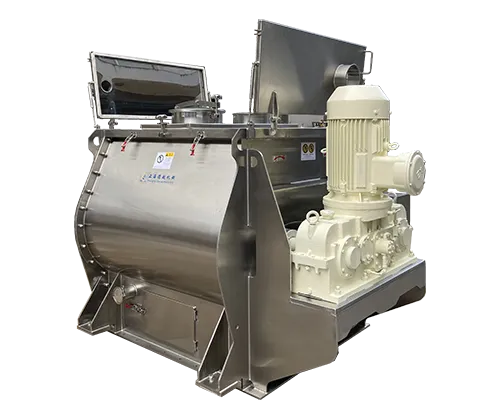
When designing a production scale mixer, collaboration between process engineers and mechanical designers is vital. The impeller selection should match the rheology of the final product. For non-Newtonian fluids, variable speed drives allow operators to adjust shear rates dynamically during different phases of the batch cycle.
Furthermore, instrumentation plays a huge role in validating the scale-up. Installing torque sensors, temperature probes, and particle size analyzers directly on the production line allows for real-time monitoring against the baseline established during laboratory mixing. This data-driven approach ensures that any deviations are caught early, maintaining product quality and reducing waste.
Conclusion
The journey from concept to mass production is fraught with technical complexities. A successful scale up mixing process relies not just on geometric scaling, but on a deep understanding of fluid dynamics, heat transfer, and mechanical constraints. By carefully selecting scaling criteria, utilizing comparative analysis, and anticipating common pitfalls, manufacturers can ensure their production scale mixer delivers consistent, high-quality results.
At DEYUE MACHINERY, we specialize in designing industrial mixing solutions that bridge the gap between laboratory precision and factory-floor efficiency. Whether you need custom impeller designs or complete system integration, our team is ready to assist you in optimizing your mixer scale-up strategy.
Contact us today to discuss your mixing requirements:
Phone: +86 13917895463
Email: [email protected]
Website: https://www.deyuemixer.com/
label:
related news