English
 Español
 Русский
 لالعربية

High Shear Mixer: Principles and Applications in Modern Manufacturing
release time:
2026-06-26
Discover how a high shear mixer achieves rapid emulsification and dispersion. Learn principles, specs, and applications. Contact DEYUE MACHINERY today.
In modern industrial processing, achieving uniform mixtures at scale requires more than simple agitation. A high shear mixer generates intense mechanical forces that break down particles, disperse immiscible liquids, and create stable emulsions in a fraction of the time conventional mixers require. From pharmaceutical formulations to food production and advanced coatings, high shear mixing has become an indispensable unit operation across diverse manufacturing sectors.
How a High Shear Mixer Works
The fundamental principle behind a high shear mixer is the creation of extreme velocity gradients within the fluid medium. Unlike low-shear agitators that rely on bulk circulation, a high intensity mixer employs a rotating stator-rotor assembly positioned at close clearance to generate localized turbulence and hydraulic shear forces far exceeding those achievable through impeller-driven flow alone.
When the rotor spins at high speeds — typically between 1,800 and 3,600 RPM depending on the model and application — it draws material into the mixing chamber through centrifugal force. The incoming fluid passes through the narrow gap between the rotor teeth and the fixed stator, where it experiences repeated cycles of particle size reduction, liquid-liquid dispersion, and homogenization. This continuous shearing action reduces droplet or particle diameters to the micrometer or even nanometer range, producing a stable and consistent product.
The design of the stator-rotor geometry plays a critical role in determining the energy dissipation rate and the resulting shear intensity. Common configurations include triangular, trapezoidal, and multi-level tooth profiles, each optimized for specific viscosity ranges and dispersion requirements. Higher tooth density generally yields finer particle size distribution but demands greater motor power to maintain rotational speed under load.
Key Components and Technical Specifications
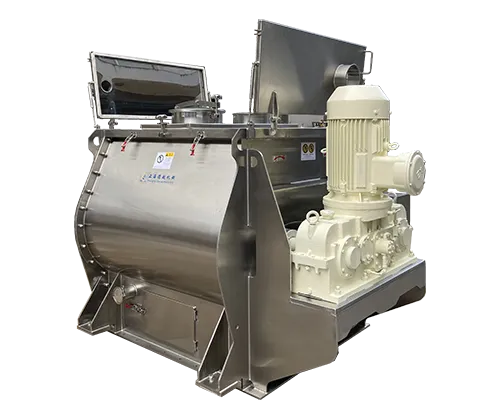
A typical industrial-grade emulsifying mixer consists of several core components that work together to ensure reliable and repeatable performance:
- Stator-Rotor Assembly: The heart of the system, machined from stainless steel (typically 304 or 316L grade) to resist corrosion and meet sanitary standards. The rotor is dynamically balanced to minimize vibration at high rotational speeds.
- Drive System: Heavy-duty motors ranging from 2 kW to 75 kW, coupled with variable frequency drives (VFD) for precise speed control. Gear reducers may be integrated to optimize torque delivery to the mixing head.
- Mixing Chamber: A cylindrical vessel equipped with baffles to prevent vortex formation and ensure uniform material flow through the shear zone. Chamber volumes range from 5 liters for laboratory-scale units to over 5,000 liters for full production lines.
- CIP System: Clean-in-place capability with spray balls and recirculation loops for hygienic applications in food, beverage, and pharmaceutical industries.
- Sealing Mechanism: Double mechanical seals or magnetic drive coupling to prevent leakage and contamination, rated for operating pressures up to 6 bar and temperatures up to 150°C.
Comparing Mixing Technologies
Selecting the right mixing technology depends on the physical properties of the materials and the desired end-product characteristics. The table below compares common industrial mixing approaches:
| Parameter | High Shear Mixer | Rotor-Stator Homogenizer | Colloid Mill | Ultrasonic Mixer |
|---|---|---|---|---|
| Max Particle Size Reduction | 1 – 50 μm | 0.5 – 20 μm | 1 – 30 μm | 0.1 – 10 μm |
| Shear Rate (s⁻¹) | 10,000 – 50,000 | 10,000 – 30,000 | 5,000 – 20,000 | 1,000 – 10,000 |
| Batch Capacity | 5 L – 10,000 L | 5 L – 2,000 L | 10 L – 5,000 L | 100 mL – 50 L |
| Viscosity Range | 1 – 50,000 cP | 1 – 10,000 cP | 50 – 100,000 cP | 1 – 5,000 cP |
| Energy Efficiency | High | Medium-High | Medium | Low |
| Continuous Operation | Yes | Yes | Yes | No (limited) |
As the comparison illustrates, a high shear mixer offers the broadest operational envelope in terms of batch capacity, viscosity tolerance, and throughput efficiency. While ultrasonic mixers achieve finer particle sizes, they are limited to small volumes and consume significantly more energy per liter processed. Colloid mills excel with very viscous pastes but lack the versatility needed for multi-phase formulations. The high shear approach strikes an optimal balance between performance, scalability, and cost-effectiveness.
Industrial Applications Across Sectors
The versatility of shear mixing technology has led to its adoption in virtually every process industry. Below are representative applications where a high shear mixer delivers measurable advantages:
Food and Beverage
Emulsified products such as salad dressings, mayonnaise, sauces, and dairy alternatives rely on high shear mixing to create stable oil-in-water dispersions. The process ensures consistent texture, prevents phase separation during shelf life, and eliminates the need for excessive emulsifier additives. Plant-based milk production, nut butter formulation, and fruit puree processing are additional examples where shear intensity directly impacts product quality.
Pharmaceutical and Cosmetics
In pharmaceutical manufacturing, high shear mixers are used for cream and ointment preparation, suspension formulation, and granulation processes. The controlled shear environment ensures uniform drug distribution within the excipient matrix, meeting strict regulatory requirements for dose consistency. Similarly, the cosmetics industry employs emulsifying mixers for lotions, shampoos, hair conditioners, and sunscreen formulations where fine particle dispersion and long-term stability are paramount.
Chemical and Coatings
Paint, ink, adhesive, and sealant manufacturers depend on high intensity mixers to disperse pigments, fillers, and thickeners into liquid binders. Proper shear mixing prevents agglomeration, improves color strength, and reduces volatile organic compound (VOC) emissions by enabling lower-viscosity formulations. The chemical sector also uses shear mixers for polymer blending, nanoparticle synthesis, and catalyst preparation.
Battery and Advanced Materials
The rapid growth of lithium-ion battery production has created new demand for high shear mixing in electrode slurry preparation. Uniform dispersion of active materials such as graphite, lithium cobalt oxide, and conductive carbon black within binder solutions is critical for battery performance and cycle life. DEYUE MACHINERY supplies specialized high shear mixers designed for the corrosive and abrasive conditions inherent in battery slurry processing.
Why Choose DEYUE MACHINERY for Your High Shear Mixing Needs
DEYUE MACHINERY designs and manufactures high shear mixers tailored to the specific requirements of each industry. Our equipment features precision-machined stator-rotor assemblies, customizable vessel configurations, and integrated control systems that allow operators to monitor and adjust shear parameters in real time. With decades of engineering expertise and a commitment to innovation, we help manufacturers improve product consistency, reduce processing time, and lower operational costs.
Whether you need a compact benchtop unit for R&D or a fully automated production-scale system, our engineering team will work with you to specify the ideal solution. We provide comprehensive support including process validation, installation, commissioning, and ongoing maintenance services.
Contact DEYUE MACHINERY today to discuss your mixing challenges and discover how our high shear mixer technology can transform your manufacturing process.
Phone: +86 13917895463
Email:[email protected]
Website:https://www.deyuemixer.com/
label:
related news