English
 Español
 Русский
 لالعربية

High Shear Mixer vs Paddle Mixer: Choosing Industrial Mixing Equipment
release time:
2026-06-29
Compare high shear mixers and paddle mixers for powder, chemical, and pharmaceutical mixing. Learn which industrial mixing equipment suits your production needs.
High Shear Mixer vs Paddle Mixer: Choosing the Right Industrial Mixing Equipment
In the complex landscape of industrial processing, selecting the correct industrial mixing equipment is not merely a matter of preference; it is a critical engineering decision that dictates product quality, production efficiency, and operational costs. For plant managers and procurement specialists overseeing processes ranging from food manufacturing to pharmaceutical formulation, the debate between a high shear mixer and a paddle mixer is common. While both machines achieve homogeneity, their underlying mechanisms and ideal applications differ significantly.
This comprehensive guide provides the technical depth necessary to make an informed decision, ensuring your facility utilizes the most effective tool for specific material properties and process requirements.
Understanding the High Shear Mixer
A high shear mixer operates on the principle of intense mechanical force to break down agglomerates and disperse solids into liquids rapidly. These machines typically feature a rotating stator and rotor assembly that creates a vacuum effect, pulling materials into the mixing chamber at high speeds. The resulting turbulence generates significant shear forces, which are essential for emulsification, dispersion, and rapid wetting.
Key Technical Advantages
- Rapid Processing: High shear mixers can reduce batch times by up to 80% compared to conventional mixing methods, making them ideal for high-throughput environments.
- Particle Size Reduction: The intense energy input effectively de-agglomerates fine powders, ensuring uniform particle distribution. This is crucial in pharmaceutical mixing where bioavailability depends on consistent dispersion.
- Emulsification Capability: Unlike simple blending, high shear mixers can create stable oil-in-water or water-in-oil emulsions by reducing droplet size to the micrometer range.
For industries dealing with viscous fluids or difficult-to-wet powders, such as in chemical mixing applications involving adhesives, sealants, or personal care products, the high shear mixer is often the superior choice due to its ability to handle high-viscosity materials without compromising mixing quality.
The Role of the Paddle Mixer
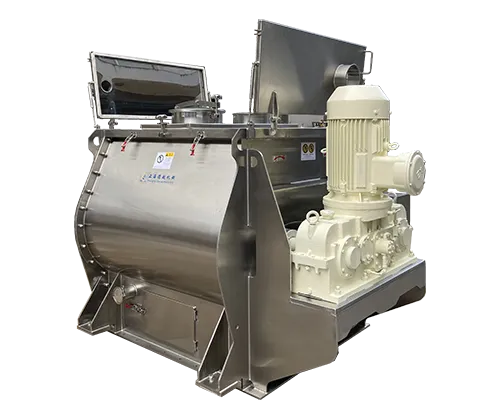
In contrast, a paddle mixer relies on gentle, convective mixing motion. Typically featuring two or more horizontal paddles rotating in opposite directions, this equipment moves bulk solids from one side of the vessel to another. It is designed primarily for dry blending or light wet mixing, rather than intense dispersion or emulsification.
Operational Strengths
- Gentle Handling: The low-shear action preserves the integrity of fragile particles. This is vital in powder mixing scenarios involving crystalline structures or coated granules that could be damaged by aggressive agitation.
- Uniformity in Dry Blends: Paddle mixers excel at achieving homogeneous distribution of dry ingredients, such as spices, flour blends, or pharmaceutical excipients, where no liquid phase is introduced.
- Cost-Effectiveness: With simpler mechanical designs and lower energy consumption, paddle mixers offer a more economical solution for processes that do not require high-intensity shear.
While they lack the dispersion capabilities of high-shear units, paddle mixers remain indispensable in the food and feed industries for large-volume dry blending operations where maintaining particle size distribution is paramount.
Technical Comparison: Selecting Based on Process Needs
To assist engineers in making a precise selection, the following comparison highlights the functional differences between these two types of industrial mixing equipment.
| Feature | High Shear Mixer | Paddle Mixer |
|---|---|---|
| Primary Mechanism | Intense turbulence and cavitation | Convective gentle blending |
| Best For | Emulsions, dispersions, wet granulation | Dry powder blending, light wet mixing |
| Viscosity Range | Low to very high viscosity | Low to medium viscosity |
| Particle Integrity | May reduce particle size (breakdown) | Preserves original particle structure |
| Cycle Time | Short (minutes) | Longer (tens of minutes) |
| Typical Applications | Cosmetics, pharmaceuticals, paints, adhesives | Food powders, animal feed, fertilizers |
Application-Specific Considerations
Pharmaceutical Mixing Requirements
In pharmaceutical mixing, regulatory compliance and reproducibility are non-negotiable. If the process involves creating a suspension or emulsion for topical creams or oral liquids, a high shear mixer ensures consistent droplet size and stability. However, for blending dry active ingredients with fillers before compression, a paddle mixer prevents segregation and degradation of sensitive compounds.
Chemical and Industrial Powder Processing
For chemical mixing applications involving reactive agents or high-viscosity polymers, the heat generation and intense agitation of a high shear mixer can accelerate reaction rates and ensure thorough wetting. Conversely, in the production of dry chemical blends like cement additives or plastic resins, the gentle action of a paddle mixer avoids electrostatic charging and dust generation, ensuring safer and cleaner operations.
Conclusion
Selecting between a high shear mixer and a paddle mixer ultimately depends on the rheological properties of your materials and the desired outcome of your process. If your goal is dispersion, emulsification, or rapid wetting of powders, the high-intensity action of a high shear mixer is unmatched. If your priority is gentle blending of dry solids or preserving particle integrity, the paddle mixer offers the reliability and efficiency required.
At DEYUE MACHINERY, we understand that every production line has unique challenges. Our team of experts is dedicated to helping you choose the optimal industrial mixing equipment tailored to your specific technical requirements. Whether you are scaling up powder mixing operations or optimizing chemical mixing processes, we provide engineered solutions that enhance productivity and product quality.
Contact us today to discuss your mixing needs:
Phone: +86 13917895463
Email: [email protected]
Website:https://www.deyuemixer.com/
label:
related news