English
 Español
 Русский
 لالعربية

release time:
0
Master the wet granulation mixing process with expert tips on equipment selection, parameter control, and quality assurance for industrial manufacturing.
Wet Granulation Mixing: Process Optimization and Quality Control
In the pharmaceutical, chemical, and food processing industries, the transition from raw powder to a stable, compressible granule is a critical step in manufacturing. This transformation is primarily achieved through wet granulation mixing, a technique that enhances the flowability, compressibility, and homogeneity of powders. For plant managers and engineering teams, mastering this process is not merely about filling a vessel with liquid; it requires a deep understanding of rheology, mechanical shear forces, and precise quality control metrics.
This article explores the technical intricacies of the wet mixing process, offering actionable insights into optimizing parameters and selecting the right granulation mixer to ensure consistent product quality and operational efficiency.
The Mechanics of Wet Granulation Mixing
At its core, wet granulation involves binding fine particles together using a liquid binder solution. The primary objective is to create granules of a specific size distribution that can be easily dried and compressed into final products like tablets or capsules. The process relies on three main mechanisms: liquid bridge formation, capillary action, and particle agglomeration.
Unlike dry mixing, which only distributes components, wet mixing induces particle collision and adhesion. The effectiveness of this interaction depends heavily on the energy input provided by the mixer. Insufficient energy results in loose, irregular aggregates, while excessive shear can lead to over-compaction, dense granules that are difficult to break down during compression, or even particle attrition.
Key Parameters for Process Optimization
To achieve reproducible results, engineers must tightly control several variables. Optimization begins with understanding how these factors interact within the wet granulation mixing chamber.
1. Impeller and Chopper Speed
Most high-shear granulation mixers utilize two distinct motion axes: an impeller for bulk movement and a chopper for size reduction. The impeller speed determines the intensity of the tumbling action, influencing how well the binder is distributed throughout the powder bed. Conversely, the chopper speed controls the granule size. Higher chopper speeds generally produce smaller, denser granules, while lower speeds yield larger, looser structures. Finding the optimal balance between these two speeds is crucial for achieving the desired particle size distribution (PSD).
2. Binder Addition Rate and Volume
The amount of binder liquid added, often expressed as the Liquid-to-Solid (L/S) ratio, directly impacts granule growth. However, the rate at which this binder is sprayed is equally important. A slow, controlled addition allows for uniform wetting and nucleation, preventing the formation of "sponge-like" granules or large, uneven lumps. Rapid addition can lead to over-wetting, causing the material to become a paste rather than discrete granules.
3. Mixing Time
Over-mixing is a common pitfall. Once the granules reach their target size and density, continued mixing can cause them to break apart or become excessively hard. Under-mixing, on the other hand, leads to poor binder distribution and inconsistent granule strength. Process validation studies typically involve sampling at intervals to determine the exact endpoint where the desired granule properties are achieved.
Quality Control Metrics in Wet Granulation
Effective quality control ensures that every batch meets strict regulatory and performance standards. Key metrics include:
- Granule Size Distribution (GSD): Measured via sieve analysis, GSD affects flow rate and tablet weight variation. A narrow distribution is often preferred for consistent compression.
- Motion Index: A measure of granule hardness and density, determined by dropping a fixed volume of granules from a set height. This correlates well with tablet tensile strength.
- Moisture Content: Post-mixing moisture levels must be monitored to ensure they are within acceptable limits before drying, preventing degradation or microbial growth.
- Flow Properties: Bulk density and angle of repose are critical indicators of how well the granules will feed into tablet presses or encapsulators.
Equipment Selection: Impact on Process Efficiency
The choice of machinery significantly influences the success of the wet mixing process. Traditional low-shear mixers rely on gentle tumbling and are suitable for fragile materials but may struggle with rapid binder distribution. In contrast, high-shear granulation mixers offer intense agitation, enabling faster granule formation and higher throughput.
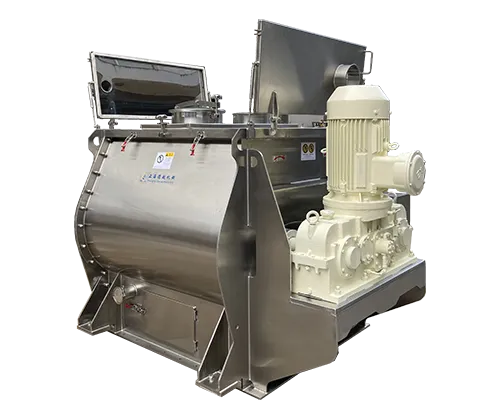
Modern top-spray high-shear mixers allow for precise control over the spray pattern and droplet size, enhancing reproducibility. Additionally, closed-system designs minimize dust generation and cross-contamination, which is vital for handling potent compounds or allergenic ingredients. When evaluating equipment, consider not just the initial cost but also the ease of cleaning (CIP/SOP capabilities) and scalability from R&D to production.
Comparative Analysis: Low-Shear vs. High-Shear Mixing
Understanding the differences between mixing technologies helps in selecting the right approach for specific formulations.
| Feature | Low-Shear Mixer | High-Shear Granulator |
|---|---|---|
| Mixing Action | Gentle tumbling, low energy | Intense agitation, high shear |
| Granule Density | Loose, porous | Dense, compact |
| Processing Time | Longer | Shorter |
| Best For | Fragile crystals, delicate APIs | Poor flow powders, high-density needs |
| Energy Consumption | Lower | Higher |
Conclusion
Optimizing wet granulation mixing is a complex interplay of mechanical design, fluid dynamics, and material science. By carefully controlling parameters such as impeller speed, binder addition rate, and mixing time, manufacturers can significantly improve product consistency and reduce waste. Furthermore, selecting the appropriate granulation mixer technology—whether low-shear or high-shear—based on the specific characteristics of the formulation is essential for achieving desired quality attributes.
For plant managers and engineers looking to enhance their production capabilities, investing in robust process optimization strategies and reliable equipment is not just a technical necessity but a competitive advantage. Ensuring rigorous quality control throughout the wet mixing process guarantees that final products meet the highest standards of safety, efficacy, and performance.
If you are ready to upgrade your granulation capabilities or need expert consultation on optimizing your current processes, contact our team of specialists today.
Contact Us:
Phone: +86 13917895463
Email: [email protected]
Website: https://www.deyuemixer.com/
label:
related news