English
 Español
 Русский
 لالعربية

Stainless Steel Mixer Food Industry: Hygiene & Compliance Guide
release time:
2026-06-26
Discover FDA compliant mixing equipment for food production. Learn hygiene standards for stainless steel mixers. Contact DEYUE today!
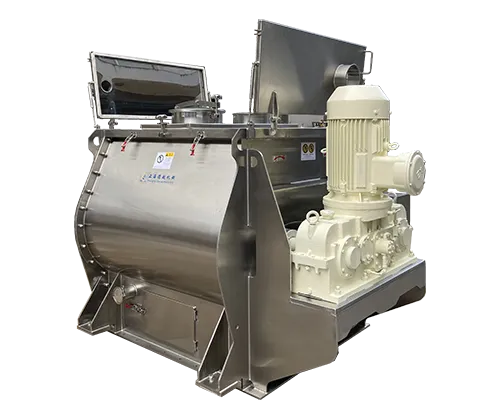
In the food processing sector, mixing equipment must meet rigorous hygiene and regulatory standards to ensure product safety and operational efficiency. A stainless steel mixer food industry solution is not merely a mechanical choice—it is a compliance requirement. DEYUE MACHINERY has engineered food grade mixer systems that satisfy FDA, EHEDG, and 3-A Sanitary Standards, serving manufacturers of dairy, bakery, meat processing, beverage, and functional food products worldwide.
Why Material Selection Matters in Food Mixing
The choice of construction material directly impacts microbial control, cleanability, and equipment lifespan. Food-grade stainless steel, specifically AISI 304 and AISI 316L grades, provides the corrosion resistance and surface finish required for sanitary applications.
AISI 304 stainless steel offers adequate performance for most dry and mildly corrosive food products, including flour blends, sugar mixes, and spice powders. Its chromium-nickel composition (18% Cr, 8% Ni) forms a passive oxide layer that resists general corrosion. However, for products with high acidity, chloride content, or salt concentration—such as tomato pastes, brine solutions, and fermented dairy—AISI 316L with molybdenum addition (2–3% Mo) delivers superior pitting and crevice corrosion resistance.
The surface finish of the mixing chamber is equally critical. The interior wall roughness (Ra value) must not exceed 0.4 micrometers for direct-product-contact surfaces. This mirror-like polish prevents microbial adhesion and biofilm formation, enabling effective Clean-in-Place (CIP) procedures. DEYUE's sanitary mixer units achieve Ra ≤ 0.3 μm through automated orbital polishing and electropolishing processes.
Regulatory Framework for Food Contact Equipment
Manufacturers deploying FDA compliant mixing equipment must navigate several overlapping regulatory frameworks:
- FDA 21 CFR Part 177.1520 – Regulates polymers intended for repeated use in food contact surfaces. All gaskets, seals, and wear parts must comply with these specifications.
- EHEDG Document 3 – Provides engineering guidelines for hygienic equipment design, including drainability, crevice elimination, and surface integrity verification.
- 3-A Sanitary Standards No. 02–11 – Specifies design criteria for mixing and blending equipment used in dairy and food processing, covering materials, weld quality, and cleanability.
- EC 1935/2004 – The European Union framework regulating materials and articles intended to come into contact with food, applicable for exports to EU markets.
DEYUE MACHINERY designs all food-grade models to meet or exceed these standards. Every unit ships with full traceability documentation, including material certificates (Mill Test Certificates per EN 10204 3.1), surface roughness test reports, and weld inspection records.
Key Design Features for Hygienic Mixing
Effective hygienic industrial mixer design incorporates multiple engineering controls to minimize contamination risk:
Weld Quality and Seam Treatment
All structural welds must be continuous, ground flush, and pass a ferrite content test (NiScope method, maximum 5 delta-ferrite for austenitic grades). Lap joints and T-joints are prohibited in product zones. DEYUE employs orbital TIG welding with inert gas backing to prevent oxidation, followed by pickling and passivation treatment to restore the chromium-rich oxide layer.
Seal and Bearing Protection
Shaft seals represent the most vulnerable point in any mixer assembly. DEYUE utilizes double mechanical seals with food-grade barrier fluid (glycerin-based, NSF H1 rated) or dry-run PTFE-carbon face seals rated for temperatures up to 180°C. Bearings are positioned outside the product zone, sealed with labyrinth arrangements and nitrogen purging to exclude moisture and particulate ingress.
Drainability and Self-Cleaning Geometry
Every internal surface must slope at a minimum of 2 degrees toward drainage points. Dead legs—any pipe or pocket where fluid can stagnate—are eliminated per EHEDG criteria (L/D ratio ≤ 1.5). The bowl geometry features a hemispherical bottom with a fully open discharge valve, ensuring zero product retention after discharge cycles.
CIP Compatibility
Fixed-in-place cleaning requires spray balls or rotating jet devices delivering turbulent flow (Reynolds number ≥ 4,000) across all wetted surfaces. DEYUE mixers include integrated CIP connection ports (Tri-Clamp DN40) and recommend a minimum cleaning velocity of 1.5 m/s for effective soil removal.
Comparative Analysis: Mixer Types for Food Applications
| Mixer Type | Best For | Max Capacity | Hygiene Rating | CIP Compatible |
|---|---|---|---|---|
| Double Cone Ribbon Blender | Dry powders, granules, spice blends | Up to 5,000 L | High (sealed design) | Yes (manual wipe or spray) |
| V-Type Blender | Dry free-flowing solids | Up to 3,000 L | Very High (no shaft seals in product zone) | Yes |
| Planetary Sigma Mixer | Viscous doughs, pastes, adhesives | Up to 2,000 L | Medium-High (shaft seal exposure) | Partial |
| Horizontal Pugmill Mixer | High-viscosity materials, meat emulsions | Up to 4,000 L | High (quick-discharge paddle design) | Yes |
| Agitated Nutsche Filter Mixer | Crystalline products, filtration-integrated mixing | Up to 1,500 L | Very High (closed system) | Yes |
Performance Specifications for Food-Grade Models
DEYUE's standard food grade mixer lineup includes the following configurable parameters:
- Bowl Volume Range: 50 L to 5,000 L (custom sizes available upon request)
- Motor Power: 1.5 kW to 75 kW, variable frequency drive (VFD) controlled for precise speed adjustment from 10 to 600 RPM
- Discharge Mechanism: Butterfly valve, ball valve, or full-opening gate valve with 150 mm to 400 mm port diameter
- Insulation Options: Jacketed bowls for heating (steam, hot water) or cooling (chilled water, brine), with thermal insulation cladding
- Safety Features: Interlocked access doors, overload protection, emergency stop buttons, and IP65-rated electrical enclosures
For high-shear applications such as emulsified sauces and mayonnaise production, DEYUE offers high-shear sanitary mixer configurations with rotor-stator assemblies operating at peripheral speeds up to 28 m/s, achieving particle reduction to 1–50 microns in a single pass.
Quality Assurance and After-Sales Support
Every DEYUE mixer undergoes a 72-hour continuous dry-run test at rated speed and a pressure test at 1.5× working pressure. Post-delivery, our engineering team provides installation supervision, operator training, and preventive maintenance schedules. Spare parts—including seal kits, wear plates, and gaskets—are stocked and ship within 48 hours globally.
Contact DEYUE MACHINERY
Selecting the right stainless steel mixer food industry partner requires technical expertise, manufacturing precision, and commitment to compliance. DEYUE MACHINERY delivers FDA compliant mixing equipment backed by over 15 years of experience in hygienic industrial mixing solutions.
Reach out for a free consultation and customized equipment recommendation:
Phone: +86 13917895463
Email:[email protected]
Website:https://www.deyuemixer.com/
label:
related news