English
 Español
 Русский
 لالعربية

Dual Shaft Sigma Blade Mixer: Design & Industrial Applications
release time:
2026-07-06
Explore the design, mechanics, and industrial applications of the dual shaft sigma blade mixer. Ideal for high-viscosity materials. Get expert insights here.
Dual Shaft Sigma Blade Mixer: Design and Industrial Applications
In the realm of heavy industrial processing, few pieces of equipment command as much respect for their versatility and mechanical efficiency as the dual shaft sigma blade mixer. Designed specifically for high-viscosity, paste-like, and semi-solid materials, this machine has become an indispensable asset in industries ranging from battery manufacturing to sealant production and plastic compounding. For plant managers and procurement specialists, understanding the intricate design and operational capabilities of a sigma blade mixer is crucial for optimizing production lines and ensuring consistent product quality.
This article provides a deep dive into the engineering principles behind dual shaft mixing technology, exploring how its unique geometry achieves superior homogenization compared to traditional single-shaft systems. We will also examine its critical industrial applications and why it remains the preferred choice for kneading mixer operations requiring intense shear forces.
The Engineering Behind the Dual Shaft Sigma Blade Mixer
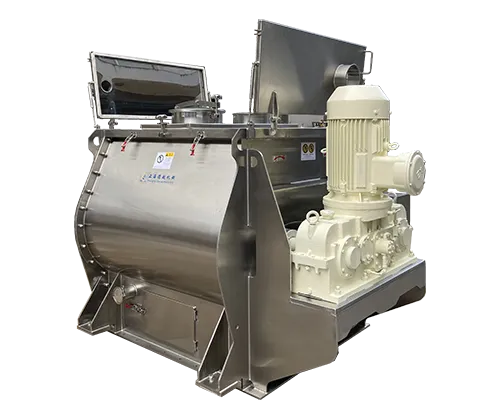
At its core, the dual shaft mixer distinguishes itself through the synchronized rotation of two intermeshing shafts housed within a U-shaped or trough-like vessel. Unlike planetary mixers that rely on orbital motion, the sigma blade design utilizes fixed, counter-rotating shafts. Each shaft is equipped with sigma-shaped blades (resembling the Greek letter Σ) that are mounted at specific angles to create a complex flow pattern.
Mechanical Dynamics and Shear Forces
The primary advantage of this design lies in its ability to generate both longitudinal and transverse mixing actions simultaneously. As the two shafts rotate towards each other, the material is drawn into the narrow gap between the blades and the vessel wall. This geometry creates high shear stress, which is essential for breaking down agglomerates, dispersing fillers, and ensuring uniform distribution of additives in viscous compounds.
Furthermore, the counter-rotation induces a "kneading" action. The material is constantly folded over itself, preventing dead zones where unmixed pockets could form. This continuous turnover ensures that every particle of the batch is exposed to the mixing elements, resulting in a homogeneous product with minimal variance. For engineers dealing with non-Newtonian fluids, this predictable shear-thinning behavior allows for precise control over viscosity during the mixing process.
Heat Management and Cooling Systems
High-shear mixing generates significant frictional heat. A well-designed sigma blade mixer incorporates a jacketed vessel, typically with circulating water or thermal oil, to maintain optimal process temperatures. This thermal control is vital in applications such as silicone rubber processing or adhesive formulation, where temperature fluctuations can alter chemical reactions or cure times. The ability to precisely manage heat input allows operators to run the dual shaft mixer at maximum efficiency without risking product degradation.
Comparative Analysis: Dual Shaft vs. Other Mixing Technologies
To fully appreciate the value of a dual shaft sigma blade mixer, it is helpful to compare it against other common industrial mixing solutions. The following table highlights key differences in performance, suitability, and operational characteristics.
| Feature | Dual Shaft Sigma Blade Mixer | Planetary Mixer | Ribbon Blender |
|---|---|---|---|
| Best For | High viscosity pastes, doughs, sealants | Medium viscosity, food-grade products | Low viscosity powders, dry blends |
| Shear Force | Very High | Medium to High | Low |
| Mixing Time | Faster for dense materials | Slower for very viscous loads | Fast for dry powders, ineffective for pastes |
| Vessel Design | U-shaped trough with jacket | Bowl with rotating/beater tools | Trough with helical ribbon agitator |
| Discharge Method | Bottom valve or tilting mechanism | Scraping bowl or bottom gate | Bottom gate valve |
As shown above, while ribbon blenders excel in dry powder handling, they struggle immensely with sticky, viscous materials. Planetary mixers offer flexibility but often lack the intense shear required for industrial-scale compounding of heavy pastes. The dual shaft mixer fills this niche perfectly, offering robust performance where other technologies fail.
Key Industrial Applications
The versatility of the kneading mixer design makes it suitable for a wide array of sectors. Below are some of the most critical applications where this equipment delivers measurable ROI through improved efficiency and product consistency.
Battery and Energy Storage
In the lithium-ion battery industry, the preparation of electrode slurries is a critical step. These slurries consist of active materials, conductive agents, binders, and solvents, forming a highly viscous mixture. A dual shaft sigma blade mixer ensures that the solid particles are evenly dispersed within the binder solution, preventing clumping that could lead to battery defects. The gentle yet thorough kneading action protects the integrity of the active materials while achieving the required rheological properties.
Adhesives and Sealants
The production of silicones, polyurethanes, and acrylic-based adhesives requires intense mixing to incorporate fillers like silica or calcium carbonate. These fillers significantly increase viscosity. The high-shear environment created by the intermeshing sigma blades breaks down filler aggregates, ensuring a smooth, consistent texture. This is particularly important for construction sealants and automotive adhesives, where application properties depend heavily on uniform mixing.
Pharmaceuticals and Cosmetics
For ointments, creams, and pastes, hygiene and precision are paramount. Modern sigma blade mixer units are constructed from stainless steel with polished surfaces to meet GMP standards. The ability to operate under vacuum conditions removes air bubbles, which is essential for transparent gels and high-quality cosmetic products. The precise temperature control also ensures that heat-sensitive ingredients remain stable during processing.
Plastics and Rubber Compounding
Masterbatch production and rubber compounding involve mixing polymers with pigments, stabilizers, and reinforcing agents. The dual shaft mixer provides the necessary torque and shear to melt and blend these components thoroughly. This results in color consistency and enhanced mechanical properties in the final plastic or rubber product.
Conclusion
The dual shaft sigma blade mixer represents the pinnacle of mixing technology for high-viscosity, paste-like materials. Its unique design, characterized by counter-rotating sigma blades and a U-shaped vessel, delivers exceptional shear forces and homogenization that other mixers cannot match. Whether you are producing battery slurries, industrial adhesives, or pharmaceutical ointments, investing in a high-quality kneading mixer ensures consistent product quality, reduced waste, and operational efficiency.
For plant managers and engineers seeking to upgrade their mixing capabilities, understanding the specific mechanical advantages of this equipment is the first step toward optimization. By selecting the right dual shaft mixer configuration, businesses can tackle the most challenging mixing problems with confidence and precision.
Contact Us for Expert Mixing Solutions
If you are looking to enhance your production line with a state-of-the-art sigma blade mixer or require a custom-engineered dual shaft mixer for your specific application, our team of experts is ready to assist. We provide comprehensive consultation, technical support, and high-performance machinery tailored to your industrial needs.
Get in touch today:
- Phone: +86 13917895463
- Email: [email protected]
- Website:https://www.deyuemixer.com/
label:
related news