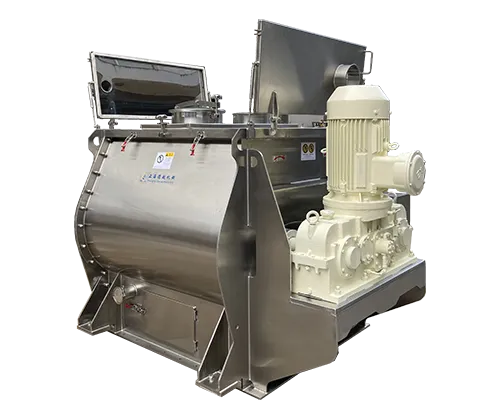
Industrial Mixer Efficiency: How to Reduce Energy Consumption by 30%


release time:

2026-06-26

In the modern manufacturing landscape, operational costs are directly tied to energy usage. For plant managers and engineering teams, the industrial mixer is of

Industrial Mixer Efficiency: How to Reduce Energy Consumption by 30%

In the modern manufacturing landscape, operational costs are directly tied to energy usage. For plant managers and engineering teams, the industrial mixer is often one of the largest continuous power consumers on the floor. Achieving industrial mixer efficiency is no longer just about throughput; it is a critical financial imperative. By optimizing mixing parameters and upgrading to advanced energy saving mixer technologies, facilities can reduce mixer energy consumption by up to 30% without compromising product quality.

This guide explores the technical mechanisms behind inefficient mixing and provides actionable strategies to achieve efficient industrial mixing through mechanical design, process optimization, and smart control systems.

The Hidden Costs of Inefficient Mixing

Many facilities operate mixers at fixed speeds regardless of load, leading to significant energy waste. Traditional mixing processes often rely on "brute force"—using high torque to overcome resistance—rather than intelligent fluid dynamics. This approach results in excessive heat generation, increased maintenance wear, and inflated electricity bills.

According to industry data, poorly optimized mixing processes can account for 15-20% of a facility's total electrical load. When you factor in the downtime required for frequent maintenance due to motor overload and seal failure, the true cost of low industrial mixer efficiency becomes apparent. Transitioning to a system designed for efficient industrial mixing addresses both the immediate energy bill and the long-term capital expenditure on repairs.

Key Strategies to Reduce Mixer Energy Consumption

Reducing energy usage requires a holistic approach that combines hardware upgrades with process refinement. The following strategies are proven methods for achieving a 30% reduction in mixer energy consumption.

1. Optimize Impeller Design and Geometry

The impeller is the heart of the mixer. Standard flat-blade turbines are often inefficient for high-viscosity applications. Switching to helical ribbon impellers or anchor designs ensures better material flow patterns, reducing dead zones where energy is wasted. Advanced energy saving mixer models utilize computational fluid dynamics (CFD) to design blades that maximize shear and circulation while minimizing turbulence-induced drag. A well-designed impeller reduces the power number (Np), which directly lowers the kW requirement per unit volume.

2. Implement Variable Frequency Drives (VFDs)

One of the most effective ways to improve industrial mixer efficiency is through speed control. Fixed-speed motors draw maximum power even when the mix is nearly complete. VFDs allow the motor speed to adjust dynamically based on the viscosity and consistency of the material. By ramping down the speed during the final stages of mixing or adjusting in real-time to load changes, VFDs can reduce energy usage by 20-40% compared to direct-on-line starters.

3. Upgrade to High-Efficiency Motors

Replacing standard induction motors with IE3 or IE4 premium efficiency motors is a foundational step. These motors are engineered to minimize electrical losses caused by heat and friction. When paired with optimized gearboxes that have higher transmission efficiencies, the overall system mixer energy consumption drops significantly. DEYUE Machinery integrates these high-efficiency components into all new efficient industrial mixing units to ensure maximum performance.

Technical Comparison: Standard vs. Optimized Mixing Systems

To illustrate the impact of these optimizations, consider the following comparison between a legacy mixing setup and a modern, efficiency-focused system.

ParameterStandard Industrial MixerOptimized Energy-Saving Mixer
Motor Efficiency RatingIE2 (Standard)IE4 (Premium Super Premium)
Drive TypeFixed Speed / Direct StartVariable Frequency Drive (VFD)
Impeller DesignGeneric Flat BladeCFD-Optimized Helical Ribbon
Power Consumption (kWh/ton)High (Baseline)~30% Lower
Maintenance FrequencyQuarterly (High Wear)Bi-Annually (Low Stress)

Process Optimization: Monitoring and Control

Achieving industrial mixer efficiency also depends on how the process is monitored. Modern energy saving mixer installations include real-time monitoring sensors for torque, temperature, and viscosity. These data points allow operators to identify inefficiencies immediately. For instance, if torque spikes unexpectedly, it may indicate a change in material density or a mechanical issue. By addressing these variables proactively, plants avoid the energy waste associated with over-mixing or running inefficient cycles.

Furthermore, implementing automated batching and timing sequences ensures that mixers do not run longer than necessary. This precision is crucial for efficient industrial mixing in industries like pharmaceuticals and food processing, where over-processing can degrade product quality while increasing energy costs.

Conclusion

Reducing mixer energy consumption by 30% is an achievable goal that delivers immediate ROI through lower utility bills and reduced maintenance costs. By focusing on industrial mixer efficiency through advanced impeller designs, VFD integration, and high-efficiency motors, manufacturers can stay competitive in a cost-sensitive market. DEYUE Machinery specializes in designing energy saving mixer solutions tailored to specific industrial needs, ensuring that every kilowatt-hour contributes to productivity rather than waste.

Ready to optimize your production line? Contact our engineering team today to discuss your specific mixing challenges and discover how we can help you achieve efficient industrial mixing.

Contact DEYUE Machinery:

label:


If you want to know more about the details of a certain company, please visit our official website where there is comprehensive and in-depth information for you to check!


Copyright © 2012-2026 Shanghai Deyue Powder Machinery Co., Ltd. All rights reserved

Leave your message

If you have any suggestions or questions for us, please feel free to contact us!

DJH Double-Shaft Paddle Mixer
We use cookie to improve your online experience. By continuing to browse this website, you agree to our use of cookie.

Cookies

Please read our Terms and Conditions and this Policy before accessing or using our Services. If you cannot agree with this Policy or the Terms and Conditions, please do not access or use our Services. If you are located in a jurisdiction outside the European Economic Area, by using our Services, you accept the Terms and Conditions and accept our privacy practices described in this Policy.
We may modify this Policy at any time, without prior notice, and changes may apply to any Personal Information we already hold about you, as well as any new Personal Information collected after the Policy is modified. If we make changes, we will notify you by revising the date at the top of this Policy. We will provide you with advanced notice if we make any material changes to how we collect, use or disclose your Personal Information that impact your rights under this Policy. If you are located in a jurisdiction other than the European Economic Area, the United Kingdom or Switzerland (collectively “European Countries”), your continued access or use of our Services after receiving the notice of changes, constitutes your acknowledgement that you accept the updated Policy. In addition, we may provide you with real time disclosures or additional information about the Personal Information handling practices of specific parts of our Services. Such notices may supplement this Policy or provide you with additional choices about how we process your Personal Information.


Cookies

Cookies are small text files stored on your device when you access most Websites on the internet or open certain emails. Among other things, Cookies allow a Website to recognize your device and remember if you've been to the Website before. Examples of information collected by Cookies include your browser type and the address of the Website from which you arrived at our Website as well as IP address and clickstream behavior (that is the pages you view and the links you click).We use the term cookie to refer to Cookies and technologies that perform a similar function to Cookies (e.g., tags, pixels, web beacons, etc.). Cookies can be read by the originating Website on each subsequent visit and by any other Website that recognizes the cookie. The Website uses Cookies in order to make the Website easier to use, to support a better user experience, including the provision of information and functionality to you, as well as to provide us with information about how the Website is used so that we can make sure it is as up to date, relevant, and error free as we can. Cookies on the Website We use Cookies to personalize your experience when you visit the Site, uniquely identify your computer for security purposes, and enable us and our third-party service providers to serve ads on our behalf across the internet.

We classify Cookies in the following categories:
 ●  Strictly Necessary Cookies
 ●  Performance Cookies
 ●  Functional Cookies
 ●  Targeting Cookies


Cookie List
A cookie is a small piece of data (text file) that a website – when visited by a user – asks your browser to store on your device in order to remember information about you, such as your language preference or login information. Those cookies are set by us and called first-party cookies. We also use third-party cookies – which are cookies from a domain different than the domain of the website you are visiting – for our advertising and marketing efforts. More specifically, we use cookies and other tracking technologies for the following purposes:

Strictly Necessary Cookies
These cookies are necessary for the website to function and cannot be switched off in our systems. They are usually only set in response to actions made by you which amount to a request for services, such as setting your privacy preferences, logging in or filling in forms. You can set your browser to block or alert you about these cookies, but some parts of the site will not then work. These cookies do not store any personally identifiable information.

Functional Cookies
These cookies enable the website to provide enhanced functionality and personalisation. They may be set by us or by third party providers whose services we have added to our pages. If you do not allow these cookies then some or all of these services may not function properly.

Performance Cookies
These cookies allow us to count visits and traffic sources so we can measure and improve the performance of our site. They help us to know which pages are the most and least popular and see how visitors move around the site. All information these cookies collect is aggregated and therefore anonymous. If you do not allow these cookies we will not know when you have visited our site, and will not be able to monitor its performance.

Targeting Cookies
These cookies may be set through our site by our advertising partners. They may be used by those companies to build a profile of your interests and show you relevant adverts on other sites. They do not store directly personal information, but are based on uniquely identifying your browser and internet device. If you do not allow these cookies, you will experience less targeted advertising.

How To Turn Off Cookies
You can choose to restrict or block Cookies through your browser settings at any time. Please note that certain Cookies may be set as soon as you visit the Website, but you can remove them using your browser settings. However, please be aware that restricting or blocking Cookies set on the Website may impact the functionality or performance of the Website or prevent you from using certain services provided through the Website. It will also affect our ability to update the Website to cater for user preferences and improve performance. Cookies within Mobile Applications

We only use Strictly Necessary Cookies on our mobile applications. These Cookies are critical to the functionality of our applications, so if you block or delete these Cookies you may not be able to use the application. These Cookies are not shared with any other application on your mobile device. We never use the Cookies from the mobile application to store personal information about you.

If you have questions or concerns regarding any information in this Privacy Policy, please contact us by email at . You can also contact us via our customer service at our Site.