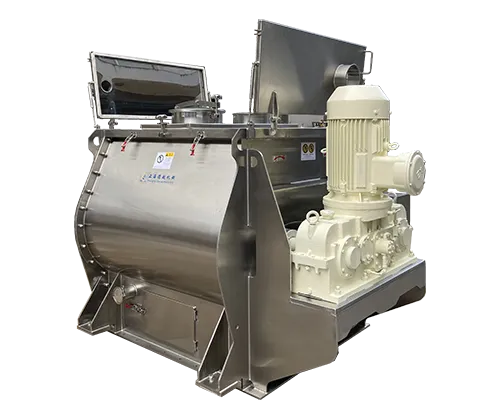
Ribbon Mixer vs Paddle Mixer: Choosing the Right Industrial Mixing Technology


release time:

2026-06-26

In the realm of bulk solid processing, selecting the correct industrial mixing technology is critical for operational efficiency, product quality, and cost mana

Ribbon Mixer vs Paddle Mixer: Choosing the Right Industrial Mixing Technology

In the realm of bulk solid processing, selecting the correct industrial mixing technology is critical for operational efficiency, product quality, and cost management. For plant managers and procurement specialists, the decision often narrows down to two dominant workhorse machines: the ribbon blender and the paddle mixer. While both serve the fundamental purpose of blending dry powders, granules, and slurries, their mechanical designs dictate distinct performance characteristics.

This comprehensive powder mixer comparison analyzes the engineering nuances of each machine to help you make an informed mixing equipment selection tailored to your specific material properties and production goals.

Understanding the Ribbon Blender

The ribbon blender, often referred to simply as a ribbon mixer, is arguably the most common type of horizontal mixer used in the chemical, pharmaceutical, and food industries. Its design features a U-shaped trough containing a central shaft with two concentric ribbons—one inner and one outer—wound in opposite directions.

How It Works

As the shaft rotates, the outer ribbon pushes material toward the center of the trough, while the inner ribbon pushes material outward. This creates a convective mixing action that ensures rapid homogenization. The counter-flow movement is highly effective for dry-to-dry mixing and light wetting applications.

Key Technical Advantages

  • High Uniformity: The dual-action mechanism provides excellent blend uniformity, typically achieving CV (Coefficient of Variation) values below 5% within minutes.
  • Versatility: Capable of handling a wide range of bulk densities, from light powders like flour to heavier granules.
  • Discharge Efficiency: Most ribbon blenders feature a bottom discharge valve (manual or pneumatic), allowing for complete emptying of the vessel, which is crucial for preventing cross-contamination between batches.

Understanding the Paddle Mixer

The paddle mixer utilizes a different mechanical approach, employing flat or shaped paddles attached to one or more rotating shafts within a horizontal trough. Unlike the ribbon's continuous helical structure, paddle mixers rely on the direct agitation of individual blades.

How It Works

Paddle mixers can operate with either single or double shafts. In a double-shaft configuration, the paddles on opposing shafts rotate toward each other, creating a strong shearing and lifting action. This design is particularly effective for materials that require vigorous agitation or have a tendency to bridge or rat-hole.

Key Technical Advantages

  • Superior Agitation: The direct impact of the paddles breaks up agglomerates more effectively than the gentle convective flow of a ribbon mixer.
  • Handling Difficult Materials: Ideal for sticky, fibrous, or cohesive materials that might clog the tight clearances of a ribbon blender.
  • Liquid Addition: Paddle mixers are often preferred when significant amounts of liquid need to be incorporated into a dry mix, as the aggressive action helps distribute the liquid evenly without clumping.

Ribbon Mixer vs Paddle Mixer: A Technical Comparison

To facilitate precise mixing equipment selection, it is essential to compare these technologies across critical performance metrics. The following table highlights the core differences between the ribbon mixer vs paddle mixer debate.

FeatureRibbon BlenderPaddle Mixer
Mixing MechanismConvective (push-pull)Shear and Lift (direct agitation)
Best ForDry-to-dry, free-flowing powdersCohesive, sticky, or fibrous materials
Blend TimeFaster for homogeneous dry blendsMay require longer times for fine segregation prevention
Discharge MethodBottom valve (cleaner)Bottom valve or tilting mechanism
Wear & MaintenanceLow wear due to minimal contact with trough wallsHigher wear potential on paddles and trough if abrasive
Cost EfficiencyGenerally lower initial investmentCan be higher depending on shaft configuration

Selecting the Right Industrial Mixing Technology

The choice between a ribbon blender and a paddle mixer ultimately depends on your specific material science challenges. Engineers must evaluate the following factors during the mixing equipment selection process:

  1. Material Cohesion: If your powder flows freely (like salt or sugar), the ribbon mixer’s gentle convective action is sufficient and energy-efficient. However, if the material is cohesive (like cement or certain plastic resins), the paddle mixer’s aggressive shear will prevent dead zones and ensure complete blending.
  2. Particle Size Distribution: Ribbon mixers excel at mixing particles of similar size. For wide particle size distributions, paddle mixers can help reduce segregation by keeping particles suspended longer through intense agitation.
  3. Heat Sensitivity: Ribbon mixers generate less frictional heat compared to paddle mixers, making them preferable for heat-sensitive pharmaceutical or food ingredients.
  4. Cleaning Requirements: For industries with strict hygiene standards (FDA/USP), the ribbon blender’s smooth interior and lack of protruding shafts (in some designs) often make it easier to clean and inspect.

Conclusion

Both the ribbon mixer and the paddle mixer are robust solutions for industrial mixing, but they are not interchangeable. The ribbon mixer vs paddle mixer decision hinges on the physical properties of your raw materials. For high-volume, free-flowing dry blends, the ribbon blender offers speed and uniformity. For complex, sticky, or heavily loaded mixes, the paddle mixer provides the necessary power and agitation.

At DEYUE MACHINERY, we understand that every application is unique. Our engineering team specializes in customizing industrial mixing technology to meet your exact throughput and quality requirements. Whether you need a standard model or a bespoke solution, we ensure optimal performance and longevity for your production line.

Ready to optimize your mixing process? Contact our experts today for a free consultation and technical assessment.

Contact DEYUE MACHINERY:
Phone: +86 13917895463
Email: [email protected]
Website: https://www.deyuemixer.com/

label:


If you want to know more about the details of a certain company, please visit our official website where there is comprehensive and in-depth information for you to check!


Copyright © 2012-2026 Shanghai Deyue Powder Machinery Co., Ltd. All rights reserved

Leave your message

If you have any suggestions or questions for us, please feel free to contact us!

DJH Double-Shaft Paddle Mixer
We use cookie to improve your online experience. By continuing to browse this website, you agree to our use of cookie.

Cookies

Please read our Terms and Conditions and this Policy before accessing or using our Services. If you cannot agree with this Policy or the Terms and Conditions, please do not access or use our Services. If you are located in a jurisdiction outside the European Economic Area, by using our Services, you accept the Terms and Conditions and accept our privacy practices described in this Policy.
We may modify this Policy at any time, without prior notice, and changes may apply to any Personal Information we already hold about you, as well as any new Personal Information collected after the Policy is modified. If we make changes, we will notify you by revising the date at the top of this Policy. We will provide you with advanced notice if we make any material changes to how we collect, use or disclose your Personal Information that impact your rights under this Policy. If you are located in a jurisdiction other than the European Economic Area, the United Kingdom or Switzerland (collectively “European Countries”), your continued access or use of our Services after receiving the notice of changes, constitutes your acknowledgement that you accept the updated Policy. In addition, we may provide you with real time disclosures or additional information about the Personal Information handling practices of specific parts of our Services. Such notices may supplement this Policy or provide you with additional choices about how we process your Personal Information.


Cookies

Cookies are small text files stored on your device when you access most Websites on the internet or open certain emails. Among other things, Cookies allow a Website to recognize your device and remember if you've been to the Website before. Examples of information collected by Cookies include your browser type and the address of the Website from which you arrived at our Website as well as IP address and clickstream behavior (that is the pages you view and the links you click).We use the term cookie to refer to Cookies and technologies that perform a similar function to Cookies (e.g., tags, pixels, web beacons, etc.). Cookies can be read by the originating Website on each subsequent visit and by any other Website that recognizes the cookie. The Website uses Cookies in order to make the Website easier to use, to support a better user experience, including the provision of information and functionality to you, as well as to provide us with information about how the Website is used so that we can make sure it is as up to date, relevant, and error free as we can. Cookies on the Website We use Cookies to personalize your experience when you visit the Site, uniquely identify your computer for security purposes, and enable us and our third-party service providers to serve ads on our behalf across the internet.

We classify Cookies in the following categories:
 ●  Strictly Necessary Cookies
 ●  Performance Cookies
 ●  Functional Cookies
 ●  Targeting Cookies


Cookie List
A cookie is a small piece of data (text file) that a website – when visited by a user – asks your browser to store on your device in order to remember information about you, such as your language preference or login information. Those cookies are set by us and called first-party cookies. We also use third-party cookies – which are cookies from a domain different than the domain of the website you are visiting – for our advertising and marketing efforts. More specifically, we use cookies and other tracking technologies for the following purposes:

Strictly Necessary Cookies
These cookies are necessary for the website to function and cannot be switched off in our systems. They are usually only set in response to actions made by you which amount to a request for services, such as setting your privacy preferences, logging in or filling in forms. You can set your browser to block or alert you about these cookies, but some parts of the site will not then work. These cookies do not store any personally identifiable information.

Functional Cookies
These cookies enable the website to provide enhanced functionality and personalisation. They may be set by us or by third party providers whose services we have added to our pages. If you do not allow these cookies then some or all of these services may not function properly.

Performance Cookies
These cookies allow us to count visits and traffic sources so we can measure and improve the performance of our site. They help us to know which pages are the most and least popular and see how visitors move around the site. All information these cookies collect is aggregated and therefore anonymous. If you do not allow these cookies we will not know when you have visited our site, and will not be able to monitor its performance.

Targeting Cookies
These cookies may be set through our site by our advertising partners. They may be used by those companies to build a profile of your interests and show you relevant adverts on other sites. They do not store directly personal information, but are based on uniquely identifying your browser and internet device. If you do not allow these cookies, you will experience less targeted advertising.

How To Turn Off Cookies
You can choose to restrict or block Cookies through your browser settings at any time. Please note that certain Cookies may be set as soon as you visit the Website, but you can remove them using your browser settings. However, please be aware that restricting or blocking Cookies set on the Website may impact the functionality or performance of the Website or prevent you from using certain services provided through the Website. It will also affect our ability to update the Website to cater for user preferences and improve performance. Cookies within Mobile Applications

We only use Strictly Necessary Cookies on our mobile applications. These Cookies are critical to the functionality of our applications, so if you block or delete these Cookies you may not be able to use the application. These Cookies are not shared with any other application on your mobile device. We never use the Cookies from the mobile application to store personal information about you.

If you have questions or concerns regarding any information in this Privacy Policy, please contact us by email at . You can also contact us via our customer service at our Site.