English
 Español
 Русский
 لالعربية

Advanced Plow Mixer for Industrial Applications: High-Shear Blending
release time:
2026-05-26
Plow mixer for fibrous, lumpy and cohesive powders: how the plowshare agitator and high-speed flying knives deliver turbulent blending, with specs and options.
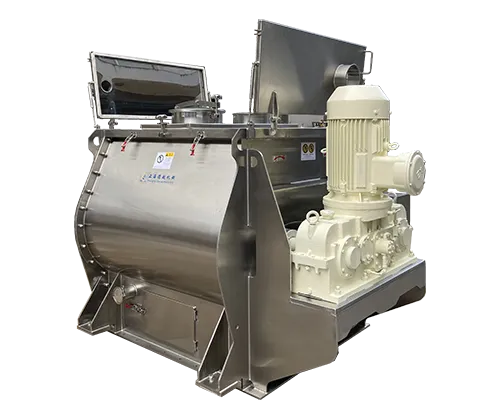
The plow mixer earns its place when the recipe fights back — fibers, small lumps, pastes and low-viscosity slurries that a ribbon or cone mixer can only smear. A plowshare agitator throws material radially while a high-speed flying-knife group shatters agglomerates, so you get turbulent, three-dimensional blending in 2–8 minutes instead of twenty.
How the plow mixer creates turbulence
The plow blades mount on the main shaft and fling particles along the cylinder wall; as the turbulent bed passes the flying-knife assembly, auxiliary motors spin the knives at thousands of rpm, scattering and recombining the mass continuously. There are no dead zones, which is why fibrous powders disperse so evenly and why solid-liquid coating stays uniform.
Where a plow mixer beats a ribbon mixer
Choose a plow when you handle cohesive, lumpy or fibrous feeds, or when you need a chopper for granules and agglomerates. For free-flowing, fragile powders a double-cone or ribbon mixer is gentler and cheaper to clean. The plow is the heavy-duty option for difficult materials across food, chemical, fertilizer, pesticide, battery and ceramic lines.
Options that match the process
Jacket or coil heating (up to 400°C for special powders), liquid spray bars for solid-liquid duties, vacuum and insulation jackets, and wear-resistant plow faces (carburizing, nitriding, tungsten-carbide spray) for abrasive feeds. Drives from Siemens, ABB or SEW with K-series or H-series gearboxes; discharge by manual, pneumatic or electric valve.
Typical plow mixer technical parameters
| Model | Working volume (L) | Total power (kW) | Chopper (kW) | Mix time (min) |
|---|---|---|---|---|
| DLT-300 | 120–180 | 5.5–11 | 2.2–3 | 2–5 |
| DLT-1000 | 400–600 | 11–18.5 | 4–5.5 | 3–6 |
| DLT-3000 | 1200–1800 | 22–37 | 7.5–11 | 4–7 |
| DLT-6000 | 2400–3600 | 45–75 | 11–15 | 5–8 |
The plow range spans roughly 100–6000 L working volume and 5–132 kW total drive power; the values above are representative points. Final model depends on bulk density, lump size and whether a chopper is specified — confirm with a trial batch before ordering.
Selecting the right configuration
Size to the real batch at 40–60% fill, pick SS304 or SS316L for the contact parts, and add only the auxiliaries your process uses. Every option adds cost and one more cleaning surface, so specify heating, spraying or vacuum only when the recipe needs them.
Maintenance notes
Seal the flying-knife shafts against dust (multi-seal design), inspect plow wear faces on abrasive runs, and CIP the jacket if you heat sticky recipes. Keep the reducer oil in spec; most "mixing noise" traces back to a tired gearbox, not the plow.
label:
related news