English
 Español
 Русский
 لالعربية

Pharmaceutical Ribbon Mixer GMP Compliance: Sanitary Design & Validation
release time:
2026-05-28
Pharmaceutical ribbon mixer for GMP-compliant API blending: sanitary SS316L design, CV targets, ribbon vs conical screw, and validation-ready features.
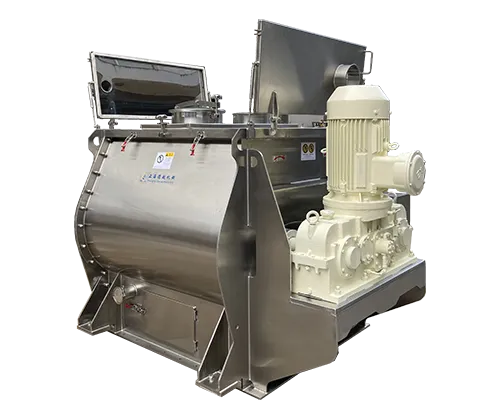
In pharmaceutical blending, GMP compliance is not a feature you add at the end — it is designed into the mixer from the contact material up. A pharmaceutical ribbon mixer must deliver a uniform active-ingredient distribution (CV below 5% for most premixes) while remaining cleanable to the validation standard your quality unit demands. The horizontal ribbon mixer is the workhorse for API premixes, granular blends and intermediate products because its counter-current agitator reaches the target CV in minutes and its U-shaped trough opens fully for cleaning and inspection.
What GMP asks of a mixer
Auditors look at three things: material of construction, cleanability and traceability. Contact parts should be SS316L (or SS304 where the recipe allows), with Ra ≤ 0.8 µm electropolished surfaces, fully welded seams and no dead corners at the discharge. Every mixer should carry a material certificate, a surface-finish report and an IQ/OQ/PQ-friendly design — dismountable end plates, a calibrated load factor and a documented mix cycle.
Ribbon vs conical screw in pharma
For free-flowing granules and API premixes the ribbon mixer is fast, economical and easy to clean. For low-residue or fragile active blends where every gram of high-value API matters, the DSHL conical screw mixer discharges with minimal heel and is the gentler choice. Both are documented in the pharma application notes.
Getting the CV right
Pre-blend the active as a concentrate, charge at 40–60% fill so the convection is strong, and keep the mix time long enough for the micro-additions to spread — typically 3–10 minutes for free-flowing powders. Sample across the batch and confirm CV below the acceptance limit before discharge; a tired gearbox or a worn blade changes the flow and shifts the CV, so keep the reducer oil in spec.
Typical pharmaceutical ribbon-mixer technical parameters (DLH)
| Model | Working volume (L) | Total power (kW) | Load factor | Mix time (min) |
|---|---|---|---|---|
| DLH-500 | 200–300 | 4–5.5 | 0.4–0.6 | 3–8 |
| DLH-1000 | 400–600 | 5.5–7.5 | 0.4–0.6 | 4–10 |
| DLH-3000 | 1200–1800 | 11–15 | 0.4–0.6 | 5–12 |
| DLH-8000 | 3200–4800 | 22–37 | 0.4–0.6 | 6–15 |
| DLH-15000 | 6000–9000 | 45–110 | 0.4–0.6 | 8–15 |
The DLH family spans 35–15000 L working volume and 2.2–110 kW total power across 17 standard models; the rows above are representative points for pharmaceutical duty. Confirm the model and finish with a test blend and a material certificate.
Sanitary and validation notes
Use SS316L contact parts, an arc discharge valve flush with the wall (no dead corners) and a fully opening cleaning door; add CIP nozzles and a contained charging port for potent compounds. Keep records of surface finish, weld maps and the qualified mix cycle for your PQ file.
Related equipment
For gentle, low-residue active blends see the DSHL conical screw mixer; for vacuum drying of the same batch the DRH vacuum drying mixer keeps the process in one line.
label:
related news