English
 Español
 Русский
 لالعربية

Powder Mixer Energy Consumption Analysis: How to Save
release time:
2026-06-14
Powder mixer energy consumption analysis: the factors (filling, speed, time) and how to cut kWh per batch.
Mixing energy is usually the hidden line item in a powder line’s operating cost. Knowing what drives it lets you cut the bill without touching product quality. Below are the factors that dominate consumption and how to act on them.
Where the consumption comes from
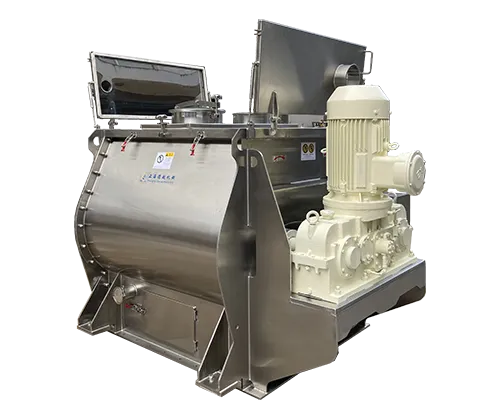
The mixer motor is almost always the dominant load: it overcomes the mass resistance, friction, and — in wet mixing — shear. A properly sized DLH ribbon mixer uses less than an oversized unit that starts empty and runs partly loaded.
The factors that dominate
- Filling level: 40–60% of total capacity is the sweet spot; beyond it, torque climbs without gaining homogeneity.
- Speed: consumption rises with the cube of speed; a variable-frequency drive (VFD) matches rpm to demand.
- Time: running past the optimum re-segregates the batch and wastes energy; validate the endpoint on a pilot scale.
- Viscosity: liquid or sticky feed → shear; a DPH paddle mixer suits it better than a ribbon unit.
Order of magnitude
| Volume | Typical power | Energy per batch |
|---|---|---|
| 1,000 L | 15.0 kW | 2.3–3.8 kWh |
| 3,000 L | 37.0 kW | 5.6–9.3 kWh |
| 5,000 L | 55.0 kW | 8.3–13.8 kWh |
How to save
- Size the mixer to the real batch, not the peak.
- Use a VFD instead of direct-on-line starting.
- Stop at the optimum and measure homogeneity in line.
- For high throughput, a continuous DJHX mixer lowers kWh per tonne.
Conclusion
Real savings come from the right batch, speed, and time — not from the brand. Request a calculation of kWh per tonne for your material.
label:
related news