English
 Español
 Русский
 لالعربية

Conical Screw Mixer vs Ribbon Blender: Which Fits Your Powder Process?
release time:
2026-10-20
Which fits your powder: conical screw or ribbon. Compare kW per m³, fill level, discharge and segregation risk using published DSHL and DLH data.
A ribbon blender and a conical screw mixer are both sold as uniform-blending machines, but they are bought for opposite reasons and they disappoint in opposite ways. Push a ribbon blender past its fill limit and you get dead zones at the trough ends. Buy a conical screw mixer expecting the cycle time of the ribbon unit it replaced and the line will run slower than the machine it replaced. This comparison is built around the three questions that actually decide the purchase: what the material is, how many kilos go in per batch, and what happens to the last few percent during discharge.
How each machine moves material
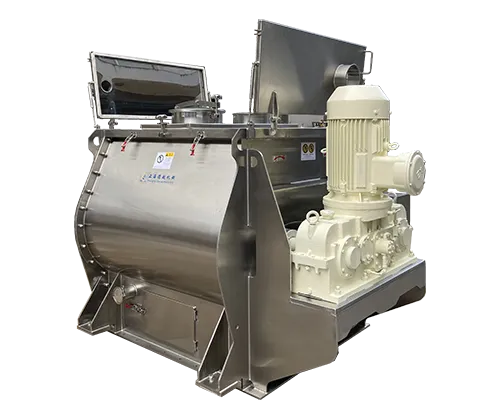
Ribbon blender. A horizontal U-shaped trough carries a single shaft fitted with an inner and an outer ribbon. The outer ribbon pushes material from the walls toward the centre, the inner ribbon drives it back out toward the ends, and the two streams meet to create forced convection through the working volume. Because the agitator sweeps the entire bed, this layout tolerates cohesive powders, pastes and modest liquid additions. Two consequences follow: material only moves while the ribbons turn, and the clearance around the discharge end decides how much stays behind after emptying.
Conical screw mixer. A vertical cone holds a screw that rotates on its own axis while orbiting the inside wall. Material is lifted from the bottom, released near the top and falls back through the rest of the vessel under gravity, so the whole charge circulates instead of being pushed along a floor. Mixing is convective but slow and gentle, and discharge is gravity-driven because a cone has no horizontal floor where material can settle out of the agitator's reach.
Decision table: match the machine to the material
| Material or process condition | Ribbon blender | Conical screw mixer | Reason |
|---|---|---|---|
| Free-flowing powder, one dominant component | Usually sufficient | Often over-specified | Both blend it; the horizontal layout is simpler to fit into a flat line |
| Fragile granules, flakes, needle crystals | Attrition risk at higher ribbon speed | Preferred | Low orbital speed and screw contact are gentler on particles |
| Minor component below one percent | Workable, prove it by sampling | Preferred | Whole-vessel circulation without a high-shear zone near the ribbons |
| Components differing widely in bulk density | Workable, watch segregation during discharge | Preferred | Gravity discharge shortens the path along which percolation happens |
| Paste, putty, high-viscosity slurry | Preferred | Not suitable | A vertical screw cannot transport a mass that does not flow |
| Frequent changeover, strict cleaning | Depends on trough and cover access | Preferred | Fewer horizontal surfaces and no trough floor to scrape out |
| Batch above 5000 L | Preferred | Possible, but tall | Cone height grows faster than volume, which drives building height |
Power per cubic metre, from published data
Both ranges are published on our product pages, so this part of the comparison can be done with numbers instead of adjectives. The table divides installed motor power by the midpoint of each model's published working-volume range.
| Model | Type | Working volume (L) | Motor (kW) | kW per 1000 L |
|---|---|---|---|---|
| DSHL-1000 | Conical screw | 600 | 5.5 | 9.2 |
| DSHL-3000 | Conical screw | 1500 | 7.5 | 5.0 |
| DSHL-5000 | Conical screw | 3000 | 15 | 5.0 |
| DSHL-10000 | Conical screw | 5000 | 18.5 | 3.7 |
| DLH-1000 | Ribbon | 350–600 | 11 | 23.2 |
| DLH-3000 | Ribbon | 1000–1500 | 18.5 | 14.8 |
| DLH-5000 | Ribbon | 2000–3000 | 30 | 12.0 |
| DLH-10000 | Ribbon | 3200–5000 | 55 | 13.4 |
At comparable volume the horizontal ribbon design carries roughly two and a half to three and a half times the installed power per cubic metre. That gap is not a defect in either machine. The ribbon has to move the whole bed horizontally against wall friction, while the cone lets gravity carry part of the transport work. If electricity is a real cost in your plant and the material tolerates a gentle action, the difference is visible every month. If you need a short cycle on a cohesive blend, the ribbon spends that power productively and the comparison stops mattering.
Published DSHL working range
The conical range runs from a 50 L laboratory unit to a 5000 L production vessel in thirteen standard sizes. Outlet size is listed because it constrains the discharge rate and therefore the realistic cycle time on large batches.
| Model | Working volume (L) | Total power (kW) | Outlet (mm) | Weight (kg) |
|---|---|---|---|---|
| DSHL-100 | 50 | 2.2 | φ150 | 180 |
| DSHL-150 | 80 | 3 | φ180 | 220 |
| DSHL-300 | 150 | 3 | φ210 | 500 |
| DSHL-500 | 300 | 4 | φ210 | 600 |
| DSHL-1000 | 600 | 5.5 | φ260 | 1200 |
| DSHL-1500 | 800 | 5.5 | φ278 | 1350 |
| DSHL-2000 | 1000 | 7.5 | φ278 | 1500 |
| DSHL-3000 | 1500 | 7.5 | φ278 | 2300 |
| DSHL-4000 | 2000 | 11 | φ390 | 2520 |
| DSHL-5000 | 3000 | 15 | φ390 | 3310 |
| DSHL-6000 | 3500 | 15 | φ390 | 3550 |
| DSHL-8000 | 4200 | 18.5 | φ390 | 3700 |
| DSHL-10000 | 5000 | 18.5 | φ390 | 4500 |
Fill level and the bulk-density trap
Every volume in these tables is quoted for powder at a bulk density of 1. That is a comparison basis, not a promise. A material at 0.4 bulk density holds forty percent of the listed mass in the same vessel, and a dense oxide at 2.5 holds two and a half times as much. Selection should start from the batch weight in kilos and work back to a volume through your own bulk density; choosing from the litre figure alone is the most common cause of an undersized mixer.
Fill practice differs between the two designs. Our ribbon range is normally charged to a maximum of about 65 percent of barrel volume, which leaves the headspace the ribbons need to fold material over. A cone keeps a usable circulation path at a low fill fraction, which is why plants running several batch sizes often prefer it, but the minimum workable charge still depends on your material and should be confirmed with a trial rather than assumed from the geometry.
What to send for an accurate selection
- Bulk density, loose and tapped, in kg per cubic metre
- Particle size range and shape, plus any tendency to agglomerate
- Moisture content, and whether liquid is sprayed into the mixer
- Batch weight in kilos, with the largest and smallest batch you expect
- Target cycle time and the number of batches per shift
- Cleaning regime: dry clean, wet wash, or clean-in-place
- Contact material: carbon steel, SS304 or SS316L
- Area classification, if solvent vapour or combustible dust applies
With those eight items a selection can be made against published dimensions instead of guesswork. Without them, any quotation is a starting point at best.
What this comparison does not cover
Cycle time and achievable homogeneity are not published numbers for either machine, and they should not be estimated from vessel volume. Particle size distribution, surface energy and the order of loading change the result more than agitator type does. The power figures above are installed motor ratings, not measured consumption at the shaft. Anyone quoting you a guaranteed blend time without a material trial is quoting a hope.
Machine data in this article comes from the DSHL conical screw mixer and DLH ribbon mixer pages. If the material is fragile, heat sensitive or carries a very small active dose, the related application notes under food additives, pigments and powder metallurgy cover the sampling and cleaning questions that follow selection.
label:
related news