English
 Español
 Русский
 لالعربية

Double-Shaft Paddle Mixer vs Ribbon Blender: Choosing for Fertilizer, Feed and High-Moisture Blends
release time:
2026-10-20
Twin-shaft paddle mixers and ribbon blenders compared for fertilizer, feed and high-moisture blends, with published power per cubic metre and model data.
Twin-shaft paddle mixers and ribbon blenders are often shortlisted for the same project, and the shortlist usually collapses on one question: how wet and how cohesive is the mix. A ribbon blender handles a stiff paste that would stall a paddle shaft, but it struggles when a high-moisture granule needs rapid liquid dispersion. A twin-shaft paddle mixer disperses liquid fast and empties cleanly, yet it costs more installed power per cubic metre and buys that speed with more wear points. This guide sets out where the line falls, using the published model data for both ranges.
Two different ways to reach uniformity
Ribbon blender. One shaft, two ribbons, one horizontal trough. The outer ribbon moves material from the walls to the centre and the inner ribbon moves it back toward the ends, so the bed is folded over itself continuously. The action is strong on cohesive and pasty materials and gentle enough on fragile ones at reduced speed, which is why the design has stayed in use for dry mortar, putty and metal powder.
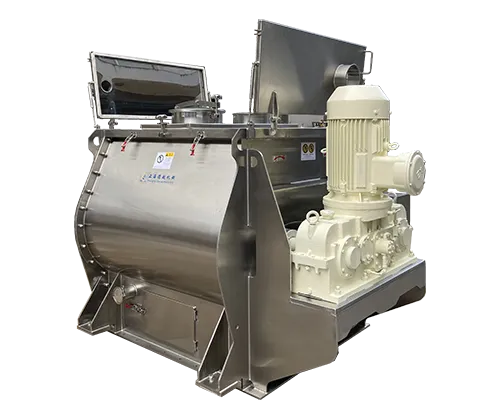
Twin-shaft paddle mixer. Two counter-rotating shafts carry angled paddles inside a twin trough. The paddles throw material into a fluidised zone in the centre, where the two streams exchange, and the same geometry gives axial, radial and circumferential movement in one pass. Because material spends part of each cycle airborne in the fluidised zone, liquid sprayed onto it is distributed quickly and lumps break up, which is the reason this design dominates water-soluble fertiliser and feed premix lines.
The decisive variable: moisture and cohesion
| Process condition | Twin-shaft paddle mixer | Ribbon blender |
|---|---|---|
| Dry powder blend, all components below one percent moisture | Fast, but often more machine than needed | Sufficient and cheaper to run |
| Liquid addition of five to fifteen percent | Preferred, spray nozzles disperse into the fluidised zone | Workable with a spray bar, slower to distribute |
| Moist granule or filter cake feed | Preferred, self-clearing between paddles | Risk of build-up on ribbons and trough walls |
| Stiff paste, putty, high-viscosity slurry | Not suitable | Preferred |
| Very fragile granules | Attrition risk from paddle impact | Gentler at reduced speed |
| Large batch with a short cycle target | Preferred | Cycle lengthens with viscosity, not with volume alone |
The pattern is consistent across projects: the drier and more free-flowing the mix, the less the twin-shaft design earns its extra power. The wetter and more cohesive the feed, the more the ribbon design starts to cost you in cleaning time and blocked discharges.
Power per cubic metre, from published data
Installed motor power is published for both ranges. Dividing it by the midpoint of each working-volume range puts the two designs on one scale, and the result is not what most buyers expect: the two ranges sit in the same band.
| Model | Type | Working volume (L) | Motor (kW) | kW per 1000 L |
|---|---|---|---|---|
| DJH-1000 | Twin-shaft paddle | 400–600 | 11 | 22.0 |
| DJH-5000 | Twin-shaft paddle | 2000–2500 | 37 | 16.4 |
| DJH-15000 | Twin-shaft paddle | 5000–8000 | 90 | 13.8 |
| DLH-1000 | Ribbon | 350–600 | 11 | 23.2 |
| DLH-5000 | Ribbon | 2000–3000 | 30 | 12.0 |
| DLH-10000 | Ribbon | 3200–5000 | 55 | 13.4 |
Between roughly 500 L and 4000 L the twin-shaft figure runs slightly above the ribbon figure at some sizes and slightly below at others, and by 5000 L the two are indistinguishable. Anyone who assumes a twin-shaft machine must cost far more to run per cubic metre will not find that assumption in the published data. What differs is how the power is used: paddles accelerate material into a fluidised zone, while ribbons push the whole bed horizontally against wall friction.
That makes specific power a poor tie-breaker between these two designs. The decision turns on moisture, cohesion, cleaning regime and cycle time instead, and those are exactly the variables no catalogue can settle.
Published DJH working range
Fourteen standard sizes cover 40 L of working volume in the laboratory unit up to 8000 L in the largest frame. Rotational speed falls from 49 to 17 r/min across the range, which is the usual scale-up compromise: torque rises as diameter grows, so shaft speed drops to keep tip speed and shear comparable.
| Model | Working volume (L) | Motor power (kW) | Speed (r/min) | Weight (kg) |
|---|---|---|---|---|
| DJH-100 | 40–60 | 4 | 49 | 260 |
| DJH-300 | 100–150 | 5.5 | 41 | 450 |
| DJH-500 | 200–300 | 7.5 | 37 | 800 |
| DJH-1000 | 400–600 | 11 | 33 | 1150 |
| DJH-1500 | 600–1000 | 15 | 33 | 1500 |
| DJH-2000 | 800–1200 | 18.5 | 31 | 2800 |
| DJH-3000 | 900–1500 | 22 | 29 | 4200 |
| DJH-4000 | 1600–2000 | 30 | 29 | 4500 |
| DJH-5000 | 2000–2500 | 37 | 23 | 6000 |
| DJH-6000 | 2200–3500 | 45 | 23 | 7000 |
| DJH-8000 | 3000–4200 | 45 | 21 | 8000 |
| DJH-10000 | 4000–5500 | 55 | 21 | 9500 |
| DJH-12000 | 4500–6000 | 75 | 17 | 10600 |
| DJH-15000 | 5000–8000 | 90 | 17 | 11500 |
Where each machine sits in a real line
In compound and water-soluble fertiliser plants the twin-shaft unit normally sits between the batching scale and the granulator, where its job is to turn several weighed streams into one uniform feed within a few minutes and to disperse any liquid additive before granulation begins. Selection notes for that duty sit under pesticides and water-soluble fertiliser.
In feed mills the same machine handles premix and molasses addition, while the ribbon blender is more often found on dry concentrate blending where the batch is small and the recipe changes often. See feed for the premix side of that comparison.
In dry mortar and putty lines the ribbon blender remains the default because the product is dense, abrasive and sometimes stiff enough to resist paddles; the relevant constraints are covered under building materials. Plastic compounding and masterbatch lines use both, depending on whether the additive arrives as powder or as a liquid that has to be distributed onto pellets.
Selection checklist
- Batch weight in kilos, not litres, with the range you expect to run
- Bulk density of every component, since a wide spread changes the discharge behaviour
- Total liquid added per batch and how it is introduced
- Whether the feed is a moist granule, a filter cake or a dry blend
- Cleaning method between recipes, and how often the recipe changes
- Cycle time target and batches per shift
- Abrasive or corrosive components that dictate contact material and clearance
- Dust or solvent hazard that determines area classification and motor protection
What this comparison does not cover
Neither range publishes a guaranteed blend time, and the figures above are installed motor ratings rather than measured shaft power. Cycle time depends on fill level, loading order and the particle size distribution of the feed far more than on the choice between two agitator types. A material trial with a defined sampling plan, taken at the start, middle and end of discharge, is the only honest way to compare the two machines for a specific formulation. Where a trial is not possible, ask for the reference installation closest to your material and speak to that plant.
Published specifications for both ranges are on the DJH double-shaft paddle mixer and DLH ribbon mixer pages. If the process also needs drying under vacuum, the DRH vacuum drying mixer combines both duties in one vessel and removes a transfer step.
label:
related news