English
 Español
 Русский
 لالعربية

How to Determine Powder Mixing Time and Coefficient of Variation (CV) in Batch Blending
release time:
2026-10-23
Engineering guide on calculating industrial powder mixing time and Coefficient of Variation (CV). Optimize batch cycles, avoid over-mixing segregation, and benchmark mixer types.
One of the most frequent questions process engineers ask mixer manufacturers is deceptively simple: "How many minutes does this machine need to blend my batch?" In industrial powder processing, any catalog or supplier that gives a single blanket number without analyzing material rheology and sampling statistics is offering guesswork rather than engineering.
Achieving a homogeneous batch is not merely a function of elapsed time—it is a statistical equilibrium governed by convective transport, particle shear, and percolation dynamics. In international quality standards (GMP, ISO, and ASTM), batch homogeneity is quantitatively measured by the Coefficient of Variation (CV). This engineering guide explains the mathematical framework of CV testing, the kinetics of the powder mixing curve, proper statistical sampling protocols, and how to optimize batch cycles across ribbon blenders and paddle mixers.
1. The Mathematical Definition of Homogeneity: What is CV%?
The Coefficient of Variation (also referred to as Relative Standard Deviation, or RSD) expresses the standard deviation of an active tracer component across multiple spatial samples as a percentage of the mean concentration:
CV (%) = ( σ / μ ) × 100%
Where σ = sample standard deviation, and μ = mean tracer concentration
In practice, a lower CV indicates a more uniform dispersion of ingredients throughout the mixer vessel. International industrial standards define acceptable CV thresholds by sector:
- Pharmaceutical Solid Dosage & APIs: CV ≤ 1.0% to 2.0% (strict FDA/EMA blend uniformity analysis).
- Infant Formula & Food Fortification Premixes: CV ≤ 3.0% to 5.0% (critical for vitamins, minerals, and micro-nutrients).
- Animal Feed Premixes & Aquafeed: CV ≤ 5.0% (high precision) to ≤ 7.0% (standard bulk feed).
- Dry Construction Mortars & Putty: CV ≤ 8.0% to 10.0% (sufficient for cement, sand, and polymer cellulose blends).
2. The Powder Mixing Kinetics Curve and Over-Mixing Hazards
Plotting CV against mixing time reveals three distinct chronological phases that govern every batch process:
- Phase 1: Macro-Convective Blending (Rapid CV Drop): During the initial 60 to 180 seconds, large packets of powder are transported across the vessel by the helical ribbons or rotating paddles. The CV plummets rapidly from >50% down toward 10–15%.
- Phase 2: Micro-Diffusion & Shear (Reaching Target Equilibrium): Individual particles exchange positions across velocity gradients and shear interfaces. The CV drops smoothly to the target ≤5% threshold. This is the optimal endpoint where the batch should be discharged.
- Phase 3: The Over-Mixing Inflexion Point (De-mixing / Segregation): Continuing to agitate beyond the optimal duration does not improve uniformity. Instead, difference in particle density, shape, and size causes percolation segregation—denser or smaller particles sift downward while lighter particles migrate upward. Mechanical energy input can also cause attrition, dusting, or electrostatic charging that ruins batch quality.
3. Statistical Thief Sampling Protocol: How to Test Accurately
A CV test is only as reliable as the sampling methodology. Taking a single scoop from the top surface or catching powder from the discharge chute produces misleading results. A rigorous qualification test requires:
- Unit-Dose Core Sampler (Powder Thief): A concentric sleeve sampling probe that captures discrete 5–10 gram samples from designated depths without disturbing adjacent layers.
- Multi-Point Matrix (Minimum 10 to 12 Points): Samples must be drawn across three planes (top surface, mid-depth, and bottom trough level) and across both ends and the center of the mixing chamber.
- Direct Tracer Assay: Homogeneity should be evaluated by quantifying a specific micro-ingredient (e.g., Vitamin C, Sodium Chloride, or Synthetic Dye via HPLC, UV-Vis spectrophotometry, or titration) rather than visual inspection.
4. Four Operational Variables That Govern Mixing Time
To reduce batch cycle times while maintaining a strict CV threshold, operators should optimize four critical variables:
1. Optimal Fill Fraction (40% to 70% of Total Volume): Overfilling a ribbon blender above the top edges of the outer flight starves the headspace, preventing powder from tumbling across the center axis and lengthening cycle times by 300%. Conversely, underfilling below 30% prevents the inner ribbon from engaging the bed, resulting in stagnant zones.
2. Agitator Tip Speed and Froude Number (Fr): Mixing kinetics depend on the balance between centrifugal force and gravitational acceleration ($Fr = \omega^2 R / g$). A standard ribbon blender operates at $Fr \approx 0.5–1.0$ (gentle convective folding), while a double-shaft paddle mixer operates at $Fr \approx 1.0–1.5$, throwing material into a weightless, fluidised zone where rapid micro-diffusion occurs.
3. Proper Loading Sequence: Always charge 50% to 70% of the major bulk carrier first. Micro-ingredients, active ingredients (below 2%), and colorants should be added into the middle core zone, followed by the remainder of the bulk carrier. Never dump micro-ingredients directly onto the bare trough floor or onto a stationary discharge valve.
4. Liquid Addition Injection Timing: When spraying liquid oils, flavors, or binder solutions, ensure the dry powder matrix has already achieved convective macro-homogeneity ($CV < 15\%$) before activating spray nozzles. Injecting liquid onto unmixed powder creates sticky lumps that trap dry actives.
Mixing Equipment Benchmark: Typical Cycle Times & CV Capabilities
| Mixer Geometry | Primary Agitator Type | Typical Dry Blend Time | Liquid Addition Handling | Minimum Target CV Achievable |
|---|---|---|---|---|
| Single-Shaft Ribbon Blender (DLH Series) | Dual counter-flow helical ribbons | 5 to 12 minutes | Moderate (spray bar required) | CV ≤ 3.0% to 5.0% |
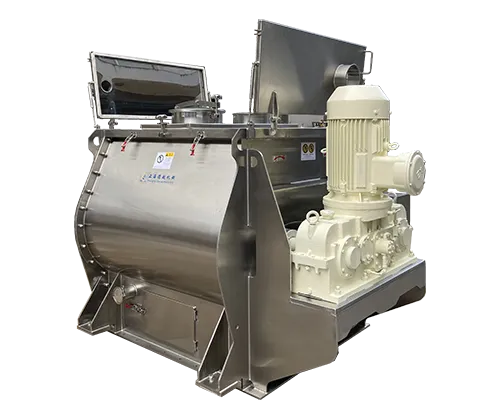
| Double-Shaft Paddle Mixer (DJH Series) | Intermeshing counter-rotating paddles | 1.5 to 3.5 minutes | Excellent (fluidised zone dispersion) | CV ≤ 2.0% to 3.5% |
| Conical Screw Mixer (DSHL Series) | Orbiting vertical lifting screw | 10 to 20 minutes | Limited (best for dry crystals) | CV ≤ 1.5% to 3.0% |
| Plow Shear Mixer (High-Shear Series) | Plowshare blades + high-speed choppers | 2 to 4 minutes | Outstanding (instant agglomerate breakup) | CV ≤ 1.0% to 2.5% |
Validate Your Formulation with Deyue Blending Trials
Because particle friction, bulk density spread, and cohesive moisture vary across every chemical and food recipe, calculating blend time theoretically should always be corroborated by empirical validation. Deyue Machinery provides laboratory-scale blending trials with comprehensive CV test reports and power consumption profiling to confirm exact cycle times before building your full-scale production line.
Explore our application engineering notes under industrial powder mixing solutions to review case studies spanning animal nutrition, pigment dispersion, battery cathode powders, and dry chemical compounding.
related news