English
 Español
 Русский
 لالعربية

Ribbon Mixer vs Plow Mixer vs Paddle Mixer: The Ultimate Comparison Guide
release time:
2026-06-27
Compare ribbon, plow & paddle mixers side-by-side. Learn which mixer fits your material, budget & production scale. Expert buying guide.
Ribbon Mixer vs Plow Mixer vs Paddle Mixer: The Ultimate Comparison Guide

When sourcing industrial mixing equipment, one of the most frequent questions we hear from buyers around the world — from Russia to Spain to Arab countries — is: which mixer should I choose? The three most common powder mixers on the market are the ribbon mixer, the plow mixer, and the paddle mixer. Each has distinct advantages depending on your material properties, production volume, and budget.
This comprehensive mixer comparison guide breaks down every critical factor so you can make an informed decision. Whether you are comparing ribbon mixer vs paddle mixer, evaluating ribbon mixer vs plow mixer, or trying to understand where a paddle mixer vs ribbon mixer stands in terms of performance, this article covers it all.
Working Principles Explained
Ribbon Mixer
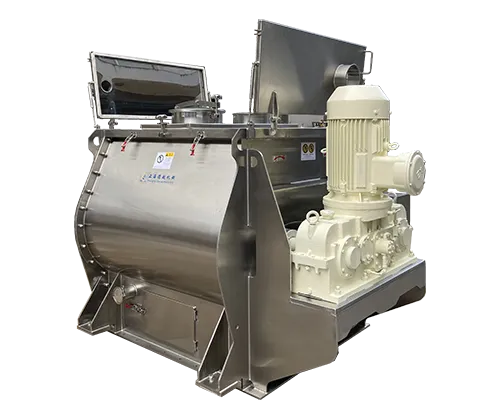
The ribbon mixer uses a U-shaped trough with a central rotating shaft fitted with double-layer ribbon blades. The inner ribbon moves material inward while the outer ribbon pushes material outward, creating a continuous convective mixing pattern. This design ensures homogeneous blending of dry powders and granules. Ribbon mixers are the most widely used powder mixing machines globally due to their versatility and proven track record in industries ranging from food processing to chemical manufacturing.
Plow Mixer
The plow mixer (also known as a犁式混合机 in Chinese) operates with a stationary or slowly rotating U-shaped or circular trough and high-speed rotating plow blades mounted on a central shaft. The plow blades lift and throw material upward and outward, creating intense turbulence and shear forces. This design excels at mixing materials with liquid binders, making it ideal for granulation processes. Plow mixers are particularly effective for cohesive and sticky powders that would cause issues in other mixer types.
Paddle Mixer
The paddle mixer features one or more horizontal shafts equipped with paddle-shaped blades inside a cylindrical or U-shaped trough. The paddles rotate at relatively low speeds, moving material along the axis of the trough and promoting gentle blending. Unlike ribbon mixers that rely on convective flow, paddle mixers primarily use mechanical displacement for mixing. They are simpler in design and often preferred for delicate materials that require minimal abrasion.
Technical Comparison: Ribbon vs Plow vs Paddle Mixer
| Parameter | Ribbon Mixer | Plow Mixer | Paddle Mixer |
|---|---|---|---|
| Mixing Mechanism | Convective mixing via dual-layer ribbons | Shear and turbulence via high-speed plows | Mechanical displacement via paddle rotation |
| Mixing Efficiency | 95-99% homogeneity | 90-98% homogeneity | 85-95% homogeneity |
| Mixing Time | 3-10 minutes | 2-6 minutes | 5-15 minutes |
| Suitable Materials | Dry powders, granules, free-flowing materials | Cohesive powders, pastes, wet granulation | Fibrous, delicate, low-abrasion materials |
| Max Capacity | Up to 20,000 liters | Up to 5,000 liters | Up to 10,000 liters |
| Liquid Addition | Limited (spray system available) | Excellent (designed for wet mixing) | Moderate (nozzles available) |
| Dead Zone Risk | Low (optimized ribbon design minimizes dead zones) | Very Low (high turbulence eliminates dead zones) | Moderate (depends on paddle configuration) |
| Maintenance Cost | Low to Moderate | Moderate to High | Low |
| Price Range (USD) | $8,000 - $80,000 | $15,000 - $120,000 | $5,000 - $40,000 |
Pros and Cons of Each Mixer Type
Ribbon Mixer — Advantages and Disadvantages
Advantages:
- High mixing uniformity for dry powders and granules
- Wide capacity range from 50L to 20,000L, suitable for both small batches and large-scale production
- Relatively low maintenance cost due to simple mechanical structure
- Can be equipped with vacuum systems for improved mixing quality
- Jacketed designs allow heating or cooling during the mixing process
- Excellent choice for powder mixer selection when dealing with free-flowing materials
Disadvantages:
- Not ideal for materials with high moisture content or liquid binders
- Ribbon blades can wear over time with abrasive materials
- Limited effectiveness with highly cohesive or sticky powders
Plow Mixer — Advantages and Disadvantages
Advantages:
- Superior performance in wet granulation and liquid-solid mixing
- Intense mixing action ensures rapid and thorough blending
- Minimal dead zones due to high turbulence
- Compact footprint compared to ribbon mixers of equivalent capacity
- Excellent for plow mixer vs ribbon mixer applications requiring binder addition
Disadvantages:
- Higher energy consumption due to high-speed rotating plows
- Greater wear on blades and trough lining with abrasive materials
- More expensive initial investment and maintenance costs
- Not suitable for fragile or easily breakable granules
Paddle Mixer — Advantages and Disadvantages
Advantages:
- Gentle mixing action protects fragile and fibrous materials
- Simple construction means lower manufacturing and maintenance costs
- Easy to clean and suitable for food-grade and pharmaceutical applications
- Good for materials that require minimal abrasion
Disadvantages:
- Lower mixing efficiency compared to ribbon and plow mixers
- Longer mixing times required for homogeneous blends
- Not recommended for cohesive or sticky powder mixtures
- Limited capacity for large-scale industrial operations
Which Mixer to Choose? Key Decision Factors
Selecting the right mixer depends on several critical factors. Here is our practical guidance for a powder mixer selection guide:
Material Properties
Density and particle size: Free-flowing powders with similar densities mix well in any type. However, when density differences are significant, a ribbon mixer vs V mixer comparison becomes relevant — ribbon mixers handle density variation better than V mixers for most industrial applications.
Moisture content: Dry powders under 2% moisture are ideal for ribbon mixers. Materials requiring liquid binder addition perform best in plow mixers. Paddle mixers sit somewhere in between, handling moderate moisture levels adequately.
Cohesiveness: Highly cohesive or sticky powders can cause bridging in ribbon mixers. In such cases, a plow mixer provides the necessary shear force to break up agglomerates effectively.
Production Scale
For large-scale continuous production exceeding 5 tons per hour, our DLH Large-Scale Ribbon Mixer is the preferred choice among our customers in Russia and Spain. Medium-scale batch production (500kg to 5 tons) can be served by either ribbon or paddle mixers depending on material characteristics. Small-scale or specialty applications may benefit from the intensive mixing capability of a plow mixer.
Budget Considerations
While paddle mixers have the lowest upfront cost, the total cost of ownership must factor in mixing time, energy consumption, and maintenance. Ribbon mixers offer the best balance of initial cost and operational efficiency for most applications. Plow mixers, though more expensive, justify their cost through faster cycle times and superior performance in wet mixing scenarios.
Industry Applications: Where Each Mixer Excels
Ribbon Mixer Industry Applications
- Food Industry: Flour, spices, protein powder, sugar blends, baking mixes
- Chemical Industry: Plastic powders, resins, pigments, detergents, fertilizers
- Construction Materials: Dry mortar, putty powder, tile adhesive, cement blends
- Pharmaceuticals: Herbal powder blends, supplement formulations, API mixing
Plow Mixer Industry Applications
- Fertilizer Production: Wet granulation of NPK fertilizers and organic compounds
- Feed Industry: Animal feed with liquid binder addition
- Chemical Granulation: Detergent powder granulation, pesticide formulation
- Building Materials: Mortar with polymer additive mixing
Paddle Mixer Industry Applications
- Fibrous Materials: Cellulose ether, wood flour, fiber-reinforced composites
- Delicate Powders: Cosmetic powders, fragile granules, light-fillers
- Heat-Sensitive Products: Products requiring gentle handling and low shear
Why Choose Shanghai Deyue Machinery?
At Shanghai Deyue Machinery, we manufacture and export high-quality mixing equipment to customers worldwide. Our ribbon mixers, plow mixers, and paddle mixers are engineered to meet international standards and customized to your specific requirements.
We have extensive experience serving markets in Russia, Spain, and Arab countries, providing reliable equipment backed by professional after-sales support. Whether you need a standard model or a fully customized solution, our engineering team works closely with you to ensure optimal mixer selection for your application.
If you are unsure about which mixer to choose for your production line, feel free to reach out. Our technical consultants will analyze your material properties, production requirements, and budget to recommend the most suitable solution.
Frequently Asked Questions
What is the main difference between a ribbon mixer and a paddle mixer?
The primary difference lies in the mixing mechanism. A ribbon mixer uses dual-layer ribbon blades that create convective flow for rapid and uniform mixing. A paddle mixer uses flat paddle blades that move material mechanically along the trough axis. Ribbon mixers achieve higher mixing efficiency and shorter cycle times, while paddle mixers provide gentler handling suitable for delicate or fibrous materials.
Can a ribbon mixer handle wet materials?
Standard ribbon mixers are designed primarily for dry powders. However, with additional spray nozzles and liquid distribution systems, they can handle limited liquid addition. For heavy wet mixing and granulation applications, a plow mixer is the better choice due to its high-shear design.
How do I choose between a ribbon mixer and a plow mixer?
Choose a ribbon mixer for dry powder blending, free-flowing granules, and large-scale production. Choose a plow mixer when your process requires liquid binder addition, wet granulation, or mixing of highly cohesive and sticky materials. The key factor is whether your application is primarily dry or involves significant liquid components.
Is a ribbon mixer better than a V mixer?
For most industrial applications involving dry powders, a ribbon mixer offers better mixing uniformity and higher throughput than a V mixer. V mixers are simple in design and excellent for gentle mixing, but they have longer cycle times and limited capacity for continuous operation. Ribbon mixers also handle density variations and larger batch sizes more effectively.
What is the typical mixing time for each mixer type?
A ribbon mixer typically achieves homogeneous blending in 3-10 minutes. A plow mixer, due to its high-intensity action, can blend materials in 2-6 minutes. A paddle mixer generally requires 5-15 minutes depending on material characteristics. These times can vary based on batch size, material density, and desired mixing uniformity.
Which mixer has the lowest maintenance cost?
Paddle mixers generally have the lowest maintenance cost due to their simple mechanical design. Ribbon mixers follow closely, with moderate maintenance requirements. Plow mixers tend to have higher maintenance costs because of the high-speed rotating plows and greater wear on components, especially when processing abrasive materials.
Can Deyue Machinery customize mixers for specific requirements?
Yes. We offer full customization including capacity, material of construction (SS304, SS316L, carbon steel with lining), heating/cooling jackets, vacuum systems, explosion-proof designs, and automated control panels. Contact us to discuss your specific mixing requirements and we will provide a tailored solution.
Conclusion
The choice between a ribbon mixer, plow mixer, and paddle mixer ultimately depends on your material characteristics, production scale, and process requirements. Ribbon mixers remain the most versatile and widely adopted solution for dry powder mixing across food, chemical, and construction industries. Plow mixers excel in wet granulation and high-shear applications. Paddle mixers serve niche applications requiring gentle handling of fragile or fibrous materials.
For a detailed mixer comparison and personalized recommendation, visit our contact page or explore our product range including the DLH Large-Scale Ribbon Mixer and Plow Mixer lines. With years of export experience to Russia, Spain, and Arab countries, Shanghai Deyue Machinery is your trusted partner for industrial mixing solutions.
Contact Us:
Phone: +86 13917895463
Email: [email protected]
Website: https://www.deyuemixer.com/
label:
related news