English
 Español
 Русский
 لالعربية

Types of Industrial Mixers: A Buyer Guide
release time:
2026-11-23
Compare key types of industrial mixers by phase, viscosity, and shear. Match ribbon, paddle, plow, cone, and high-shear mixers to your production line.
Plant engineers often buy blending tanks by volume alone. That shortcut leads to costly bottlenecks. A 2,000 L trough that blends dry flour cleanly will stall on a thick cream. A fast blade that wets pigment in water will leave dead zones in a heavy paste.
Choosing among the core types of industrial mixers means looking past tank size. Match the machine to your material phase, viscosity in centipoise (cP), and shear need. This guide covers the main industrial mixer types for dry powders, liquids, and pastes, showing how each unit works and where its limits sit.
How Industrial Mixers Are Classified: Phase, Viscosity, and Shear
Engineers sort industrial mixing gear along three clear lines: phase, viscosity, and shear. Checking these three factors first prevents most sizing errors before you ask for a quote.
First, check the material phase. Dry bulk solids need lifting, folding, and gentle tumbling to reach an even blend. Liquids and thin slurries need strong pumping flow and fluid shear. Wet powders and pastes sit in the middle. Sticky bridges hold their particles together and resist plain gravity flow.
Second, measure viscosity for any liquid or paste batch. Published guides from Silverson and Charles Ross split liquid work into three bands:
- Low-to-medium viscosity (1 to 10,000 cP): Plain propellers, turbines, and rotor-stator heads move the whole tank on their own.
- Medium-to-high viscosity (10,000 to 50,000 cP): Fluid drag jumps sharply. A fast center head needs a slow wall scraper to feed thick product back in.
- High-viscosity pastes (above 50,000 cP): A single fast head spins in a hollow hole and starves. These jobs need dual-shaft, triple-shaft, planetary, or kneader mixers.
Third, check flow behavior, since viscosity often shifts mid-batch. Newtonian fluids, such as water and light oil, keep one steady viscosity at any speed. Non-Newtonian fluids act differently and change motor load fast.
Shear-thinning blends, like paint and cream, thin out as shaft speed climbs. They need high startup torque, then drop to a lighter load once flow starts. Shear-thickening slurries push back harder as speed rises. Running them too fast spikes amp draw and heats the batch.
Dry Powder and Bulk Solid Mixers
Dry blending does not rely on hydraulic turbulence; instead, a powder mixer moves solid particles along intersecting paths until components of different particle sizes and densities reach statistical uniformity. Selecting the wrong agitator geometry creates dead zones, crushes friable granules, or triggers particle segregation during discharge.
Horizontal Ribbon Blenders
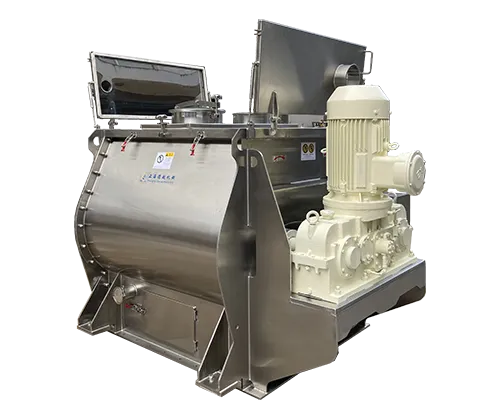
A ribbon blender is the workhorse for free-flowing dry powders, granules, and mildly cohesive blends. Inside its U-shaped trough, a single horizontal shaft drives inner and outer helical ribbons in opposing axial directions. The outer ribbon sweeps material from both end plates toward the center discharge valve, while the inner ribbon pushes material from the center back toward the ends. Because the outer ribbon keeps a tight clearance along the trough wall, this counter-current loop turns the bed over cleanly without stagnant bottom layers.
As vessel width increases, shaft rotational speed must step down proportionally. A larger-diameter ribbon travels a greater peripheral distance per revolution, so keeping tip speed controlled prevents frictional heating and gearbox overload. In the DLH large-scale ribbon mixer series from Deyue Machinery (covering production batches from 2,000 L to 15,000 L, with smaller DLH frames serving runs below 2,000 L), shaft speed scales from 31 rpm on the 5,000 L frame down to 17 rpm on the 30,000 L frame as motor power climbs to handle heavier bed torque. Keep batch loading at or below the 65% maximum fill limit so the top of the ribbon sweeps through free headspace and folds the upper layer back into the core.
Double-Shaft Paddle Mixers
When a production line demands shorter cycle times or blends ingredients with wide bulk density differences, a paddle mixer outperforms a single-shaft ribbon trough. Inside a W-shaped vessel, two parallel counter-rotating shafts carry angled paddles that overlap and sweep upward through the center zone.
As the interleaved paddles lift material from both troughs simultaneously, particles enter a fluidized, low-gravity zone at the top of the chamber. Because buoyancy and weight differences temporarily lose their effect in this fluidized zone, heavy mineral salts and lightweight fibers intermesh in seconds without settling into layers. That rapid, uniform lift makes the DJH double-shaft paddle mixer a standard choice for feed premixes, dry mortar, and delicate formulations. Stepping shaft speeds down from 49 rpm on compact 40 L units to 17 rpm on 8,000 L vessels preserves this gentle toss, protecting friable granules and fragile pellets while preventing segregation.
Plow Mixers for Cohesive and Wet Batches
Dry powder loses flowability and becomes cohesive as soon as you spray in oil, water, or viscous binders. Where standard ribbons or gentle paddles merely roll wet lumps across the bed, a plow mixer applies intense radial and axial throw to break up agglomerates.
Inside a cylindrical drum, wedge-shaped ploughshares rotate at higher peripheral speeds, slicing through the bed and hurling material into a turbulent 3D suspension. Whenever a formulation requires liquid coating, binder atomization, or fiber dispersion, high-speed side choppers bolt through the lower drum wall right beneath the spray nozzles. These choppers shear wet lumps immediately before they can snowball into oversized balls. On the DTH plow mixer series, main shaft speed steps from 120 rpm on compact 30 L drums down to 23 rpm on 12,000 L industrial vessels to hold consistent fluidization, while independent 1.5 to 7.5 kW chopper heads deliver localized shear for wet granulation.
Conical Screw and Tumbling Mixers
Certain dry formulations cannot tolerate horizontal blade drag, packing-seal friction, or mechanical heat buildup. Vertical or tumbling geometries are therefore preferred for heat-sensitive crystals, coated particles, and trace-ratio premixes.
A conical screw mixer suspends one or two cantilevered screws inside a vertical cone vessel. Each screw rotates on its own axis to lift powder gently up the conical wall while orbiting the perimeter, letting material cascade back down through the center by gravity. Because the bed circulates in smooth 3D convection without high-speed impact, the DSHL conical twin-screw series blends 1:1000 trace additives without segregation. It draws just 2.2 to 18.5 kW across its 50 to 5,000 L working range and drains cleanly through the bottom apex valve. For zero-shear applications, tumbling vessels—such as V-cone, double-cone, and 3D mixers—remove internal shafts completely and fold powder by gravity alone as the shell rotates.
Liquid, Emulsion, and High-Viscosity Mixers
Liquid processing shifts the engineering focus from particle paths to bulk tank turnover and droplet breakup. Every liquid mixer must balance two duties: macro-circulation that sweeps the full vessel volume, and local shear that wets out powders or ruptures immiscible droplets.
Low-to-Medium Viscosity Mixers (1 to 10,000 cP)
Below 10,000 cP, fluid resistance is low enough for a single shaft to circulate the entire vessel, allowing axial propellers or pitched-blade turbines to handle simple blending and heat transfer efficiently.
However, open impellers cannot generate the energy density needed to form fine emulsions, hydrate gums without "fish-eyes," or break pigment clusters. Those duties require a high shear mixer equipped with a precision rotor-stator workhead. As the high-speed rotor draws liquid and solids into the center of the head, centrifugal force drives the stream through a narrow 0.1 to 0.5 mm radial gap before ejecting it through slotted stator openings. Per Silverson and Charles Ross engineering benchmarks, standard rotor-stator workheads run at tip speeds of 15 to 20 m/s (with ultra-high-shear units reaching 25 to 55 m/s), focusing intense shear into the gap to shrink droplet and particle sizes fast.
High-Viscosity and Dual-Drive Systems (Above 10,000 cP)
Once batch viscosity climbs past 10,000 cP, a standalone high-speed workhead loses effectiveness and struggles to circulate the batch. The rotor carves a localized, overheated cavern around itself while thick paste near the vessel wall stagnates, and above 50,000 cP a lone high-shear head starves completely.
Processing heavy coatings, creams, and adhesives therefore requires separating bulk flow from high-shear dispersion inside a multi-shaft vessel such as the DYH liquid mixer. In this dual-drive layout, a low-speed anchor frame (1.5 to 45 kW at 65 down to 12 rpm) sweeps the jacketed wall and folds thick paste inward toward a separate high-speed dispersion shaft (3 to 55 kW at 0 to 1,450 rpm up to 3,000 L, or 0 to 960 rpm on 5,000 to 15,000 L vessels). Splitting torque and tip speed across two motors lets one vessel wet out powders and hold even heat up to 50,000+ cP, while dense putties well past that range move to triple-shaft, planetary, or sigma-kneader systems.
Vacuum Drying Mixers for Moisture-Sensitive Processes
When a chemical, pharma, or battery line must dry a wet filter cake right after mixing, moving damp product to a separate dryer adds oxidation risks, solvent loss, and extra handling. A vacuum drying mixer—such as the DRH series—combines low-shear mixing, a heated jacket, and vacuum pull in one sealed vessel. Lower pressure drops the boiling point of water or solvents while steady turning renews particle contact against the warm shell for clean solvent recovery.
Side-by-Side Comparison of Industrial Mixer Types
Use the engineering matrix below to match your material phase, viscosity band, and shear requirement against verified capacity and drive ranges.
| Mixer Type | Material Phase / Viscosity | Shear Level | Working Volume | Power & Drive Config | Best-Fit Applications |
|---|---|---|---|---|---|
| Ribbon Blender (DLH) | Dry powders, granules, mildly cohesive solids | Low–medium | 2,000–15,000 L (large); <2,000 L (small) | 30–110 kW; 31–17 rpm | Bulk dry blending, food powders, chemicals |
| Paddle Mixer (DJH) | Dry powders, wide bulk-density gaps, friable granules | Very low (fluidized) | 40–8,000 L (14 models) | 4–90 kW; 49–17 rpm | Fast premixes, animal feed, dry mortar |
| Plow Mixer (DTH) | Cohesive powders, fibers, wet powder-liquid runs | High (with choppers) | 30–12,000 L | Main 3–110 kW (120–23 rpm); choppers 1.5–7.5 kW | Liquid spraying, deagglomeration, wet granulation |
| Conical Screw (DSHL) | Fragile, heat-sensitive, or trace-additive powders | Very low | 50–5,000 L (13 models) | 2.2–18.5 kW orbital screw | 1:1000 trace blends, low-residue discharge |
| Liquid / High-Shear (DYH) | Liquids, emulsions, pastes (1–50,000+ cP) | High + wall scraping | 100–15,000 L total (60–70% fill) | Anchor 1.5–45 kW (65–12 rpm) + disperser 3–55 kW (0–1,450 / 0–960 rpm) | Coatings, creams, pigment dispersion, emulsions |
| Vacuum Drying (DRH) | Wet cakes, solvent-rich or heat-sensitive solids | Low–medium | Custom batch sizes | Sealed jacketed vacuum-agitated drive | Solvent recovery, one-pot mixing and drying |
Notice how power and speed shift across these types of mixers. High-shear wet units pack far more kW per liter than gentle cone blenders. Always size your motor for your heaviest batch, not your lightest one.
5-Step Engineering Checklist Before Requesting a Mixer Quote
Gather five core facts before sending an RFQ to prevent undersized drives and costly retrofits.
- Bulk density and particle size distribution: Measure loose and tapped bulk density in kg/m³. Dense mineral powders demand higher starting torque and heavier reducer service factors than low-density botanical powders of the same volume, while wide particle-size or bulk-density differences require fluidized or orbital mixing to prevent segregation.
- Viscosity and rheological curve: Measure liquid or paste viscosity in cP across your full operating temperature range, and confirm whether the batch is shear-thinning (pseudoplastic) or shear-thickening (dilatant) so startup and running torque are sized accurately.
- Liquid addition ratio: Specify the exact percentage of oil, water, or binder sprayed into dry powder. Light surface sprays can run in a ribbon trough, whereas higher liquid loads that form cohesive agglomerates require a plow mixer with high-speed choppers.
- Working volume versus total vessel volume: Never confuse total geometric volume with usable batch capacity. Most industrial batch mixers operate between 60% and 70% fill, and DLH horizontal ribbon blenders cap loading at 65% so the upper ribbon can fold the bed cleanly.
- Sanitary finish, shaft seals, and hazard class: Specify contact steel grade (SS304 or SS316L), internal surface finish, CIP/washdown access, shaft sealing (packing gland, air-purged, or mechanical seal), and ATEX/explosion-proof motor ratings upfront.
Ready to Size Your Next Industrial Mixer?
Need help matching a machine to your exact formulation? Send your bulk density, target viscosity, liquid addition ratio, and batch size to the engineering team at Deyue Machinery. Our engineers will review your process parameters and recommend the right agitator geometry, motor torque, and sealing configuration. Message us on WhatsApp at +86 18101955152 or submit your specifications through our site inquiry form for a fast sizing evaluation.
Frequently Asked Questions About Types of Industrial Mixers
Here are clear engineering answers to the four sizing questions plant managers ask most when comparing types of industrial mixers.
What is the difference between a ribbon blender and a paddle mixer?
A horizontal ribbon blender uses inner and outer helical ribbons to drive dry powder in opposing axial loops through a U-shaped trough, making it a cost-effective workhorse for uniform, free-flowing solids. A double-shaft paddle mixer uses twin counter-rotating shafts to lift material into a fluidized low-gravity zone, delivering shorter mixing cycles, gentler handling for friable granules, and far less segregation across ingredients with wide bulk density differences.
Which industrial mixer handles viscosities above 10,000 cP?
Above 10,000 cP, a standalone high-speed rotor-stator or dispersion disc struggles to circulate paste near the vessel wall. You need a dual-drive system—combining a low-speed wall-scraping anchor with a high-speed dispersion shaft (such as the DYH series for 1 to 50,000+ cP)—to feed viscous material continuously into the shear zone. Above 50,000 cP, plants typically move to triple-shaft, planetary, or sigma-kneader systems.
How do I convert total mixer volume to actual working volume?
Multiply total geometric vessel volume by 0.60 to 0.70 for most industrial batch mixers; for example, a 1,000 L vessel typically yields 600 to 700 L of usable working capacity. On DLH horizontal ribbon blenders, keep batch loading at or below 65% of total volume so the upper ribbon sweeps through headspace and folds the batch effectively.
When should I choose a conical screw or tumbling mixer over a horizontal mixer?
Choose a vertical conical screw mixer (such as the DSHL series) or a shaftless tumbling vessel (V-cone, double-cone, or 3D mixer) for friable granules, heat-sensitive powders, or low-residue sanitary batches. Conical twin-screw mixers also blend 1:1000 trace additives without segregation while drawing significantly less power than high-speed horizontal agitators.
Next
related news