English
 Español
 Русский
 لالعربية

Plowshare Mixer for Building Materials: Putty & Dry Mortar Mixing
release time:
2026-06-28
Plowshare mixer for building materials: uniform putty and dry-mortar blending, fibres and agglomerates dispersed in minutes, with specs and plant notes.
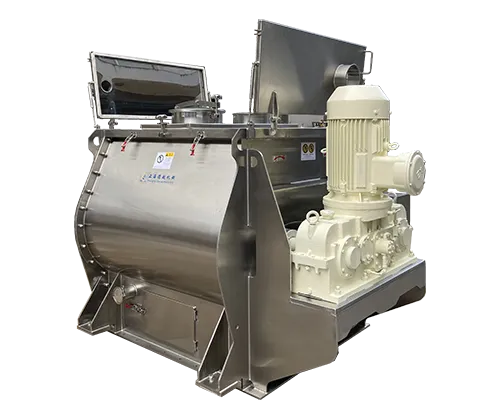
Dry mortar, tile adhesive and putty live or die on consistency. A batch that is wet in one scoop and dry in the next produces shading, poor adhesion and rejected walls. The plowshare mixer is the standard for building-materials plants because its turbulent, high-shear bed disperses fibres, thickeners and small lumps uniformly in 2–8 minutes — far faster than a gentle ribbon can handle a cohesive dry-mortar recipe.
Why putty and dry mortar need a plow
Dry-mortar recipes carry cellulose ether, redispersible powder, fibres and filler that a ribbon mixer only smears. The plow mixer flings material radially while high-speed flying knives break agglomerates, so the mix stays uniform at higher fill and higher viscosity. It is the heavy-duty choice across building-materials lines — putty, tile adhesive, render and dry mortar.
Plow vs ribbon for mortar
For free-flowing, lower-viscosity dry blends a ribbon mixer is cheaper and easy to clean. For cohesive, fibre-laden or high-viscosity mortars the plow keeps the convection strong and the cycle short. Most dry-mortar plants run plow or twin-shaft paddle lines for exactly this reason.
Additives and liquid dosing
Pre-blend trace additives as a concentrate, dose liquid (water, latex, additive) through a spray bar so it coats evenly, and keep fill at 40–60% so the bed stays turbulent. After coloured or coated runs, dry-clean then wet-CIP the trough before a different shade.
Typical building-materials plow-mixer technical parameters (DLT)
| Model | Working volume (L) | Total power (kW) | Chopper (kW) | Mix time (min) |
|---|---|---|---|---|
| DLT-300 | 120–180 | 5.5–11 | 2.2–3 | 2–5 |
| DLT-1000 | 400–600 | 11–18.5 | 4–5.5 | 3–6 |
| DLT-3000 | 1200–1800 | 22–37 | 7.5–11 | 4–7 |
| DLT-6000 | 2400–3600 | 45–75 | 11–15 | 5–8 |
The plow range spans roughly 100–6000 L working volume and 5–132 kW total drive power; the rows above are representative points for dry-mortar duty. Confirm the model with a test blend of your actual recipe and filler.
Plant and sanitary notes
Use SS304 contact parts for most mortars, an arc discharge valve flush with the wall, and a fully opening cleaning door for fast colour change. Bind the vessel to ground for conductive powders, and keep the reducer oil in spec to avoid noise and downtime.
Related equipment
For continuous dry-mortar lines see the DJHX continuous twin-shaft paddle mixer; for gentle mineral blends the DSHL conical screw mixer is an alternative where low residue matters.
label:
related news